The biggest difference between people who get incredible results from AI and people who get generic, forgettable output is not which AI tool they use. It is how they ask. A vague prompt produces a vague answer. A specific, structured prompt produces something that actually saves you time. This guide gives you the complete framework — the prompt anatomy, the ToolFlow Prompt Formula, the most common mistakes, and 100 example prompts across the most important categories. The full collection of 500 prompts is in the free ebook below.
Download the Free Ebook
500 AI Prompts That Actually Work (2026)
Get all 500 prompts in one beautifully designed PDF — 25 categories, ready to copy and paste into any AI tool. Includes the prompt engineering guide, formula cheatsheet, AI workflow diagrams, and bonus prompt templates. Read offline, print it, or keep it open while you work.
- 500 copy-and-paste AI prompts
- 25 prompt categories
- Prompt engineering guide
- The ToolFlow Prompt Formula
- AI workflow diagrams
- Prompt cheatsheet
- Printable A4 PDF
- Offline access
- Free forever
- No signup required
What is an AI prompt?
An AI prompt is the instruction you send to an AI model. It is the input that determines the quality of the output. Think of it like a brief you give to a freelancer — the clearer the brief, the better the work. The hazier the brief, the more time you spend on revisions.
Modern AI models like ChatGPT, Claude, and Gemini are extraordinarily capable. They can write, code, analyse, summarise, translate, brainstorm, and plan. But they only know what to do based on what you tell them. A prompt that says "write me a blog post" gives the AI almost no useful information. A prompt that says "you are a content strategist writing for SaaS founders — write a 1,000-word beginner guide to customer churn, using H2 headings and a conversational tone" produces something usable in the first draft.
Why prompts matter more than which AI you use
Most people switch between AI tools looking for the one that produces better answers. The uncomfortable truth is that the tool matters far less than the prompt. The same well-structured prompt will consistently outperform a vague prompt on any AI tool, including the most advanced models available.
Prompt engineering — the practice of crafting precise, structured AI instructions — is one of the highest-leverage skills you can develop in 2026. It costs nothing, takes an afternoon to learn the basics, and immediately improves every AI interaction you have.
The anatomy of a great AI prompt
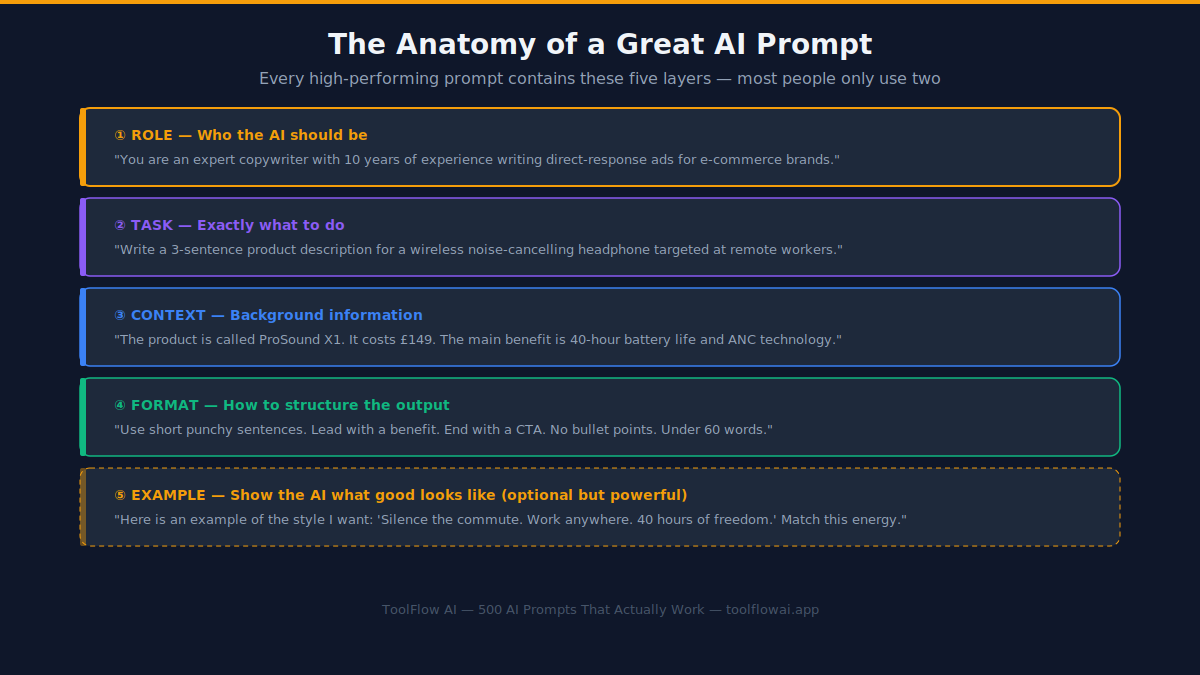
Every high-performing prompt contains some combination of five elements. You do not need all five every time, but the more you include, the better the output.
① Role — who the AI should be
Assigning a role calibrates the AI's perspective, vocabulary, depth of knowledge, and tone in one sentence. "You are an expert copywriter with 10 years of direct-response experience" produces completely different output than "you are a beginner blogger". The role tells the AI which version of itself to activate.
Examples: "You are a senior Python developer." / "You are a professional resume writer." / "You are a Michelin-starred chef writing for home cooks."
② Task — exactly what to do
The task is the core instruction. Be as specific as possible. "Write a blog post" is a task. "Write a 1,200-word beginner guide to sourdough bread with H2 headings and a 5-step method section" is a much better task. Specificity collapses the solution space and reduces the AI producing something technically correct but practically useless.
③ Context — background the AI needs
Context is the information the AI cannot guess. Your product's name and price. Your target audience's specific concerns. The platform you are writing for. The competitor you are trying to differentiate from. Without context, the AI fills in the gaps with generic assumptions.
④ Format — how to structure the output
Specify word count, heading structure, paragraph length, list format, table structure, or any other output constraint. "Under 200 words" or "return a JSON object with three keys" are format instructions. Without them, the AI chooses a format — and it may not match what you actually need.
⑤ Example — show the AI what good looks like
Providing one example of the style, tone, or structure you want is the single most underused prompting technique. "Match the tone of this example: [paste example]" instantly calibrates the AI to your preferences in a way that adjectives alone cannot. This technique is called few-shot prompting and it works remarkably well.
The ToolFlow Prompt Formula
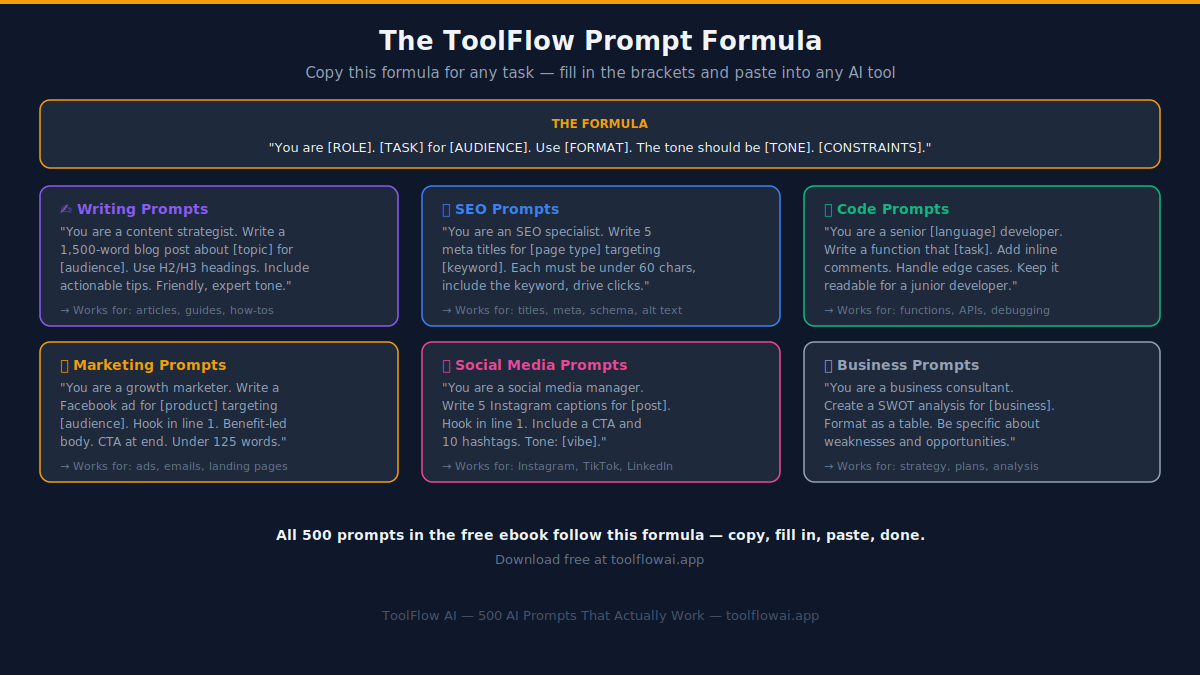
Rather than approaching every prompt from scratch, use this formula as your starting point:
"You are [ROLE]. [TASK] for [AUDIENCE]. Use [FORMAT]. The tone should be [TONE]. [CONSTRAINTS or EXAMPLE]."
This covers the five elements in a natural sentence structure. You do not need to use every slot every time — but the more you fill in, the better the output.
Bad prompt vs good prompt: a real example
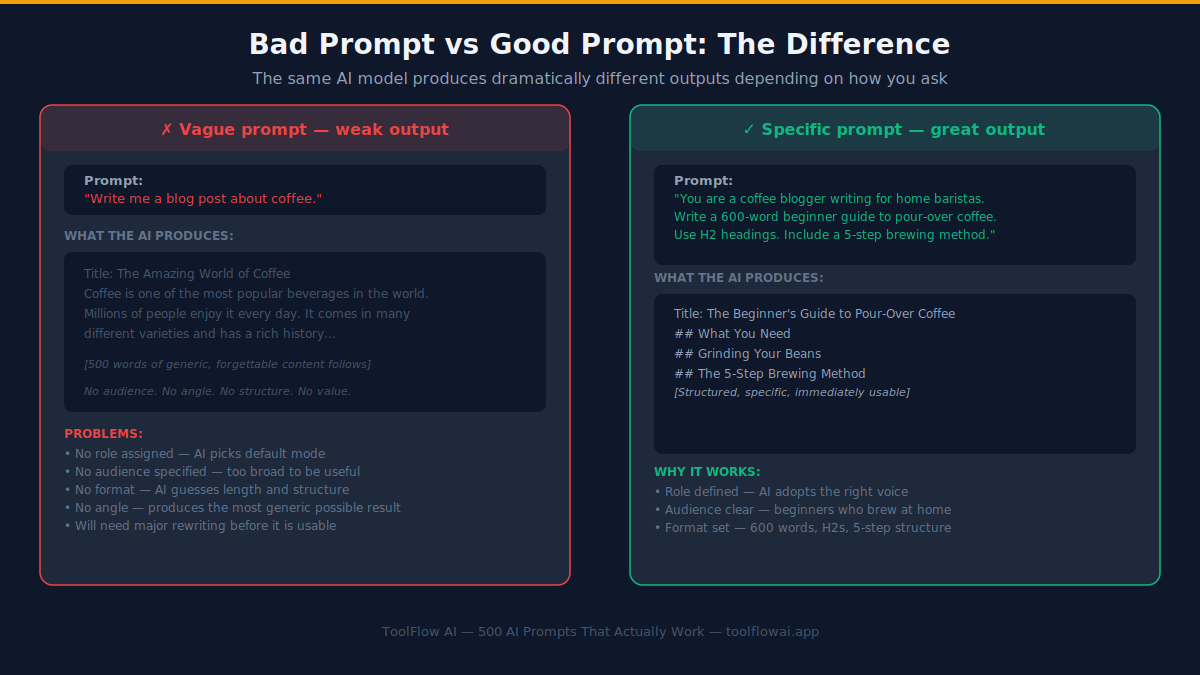
| ❌ Weak prompt | ✅ Strong prompt |
|---|---|
| "Write a blog post about marketing." | "You are a B2B marketing expert. Write a 1,000-word guide to email list segmentation for SaaS companies. Use H2 headings. Practical, concise tone." |
| "Help me with my resume." | "You are a professional resume writer. Rewrite this experience bullet to be achievement-focused and quantified: [paste bullet]. Keep under 25 words." |
| "Write some Instagram captions." | "You are a social media manager for a sustainable fashion brand. Write 5 Instagram captions for a new eco-friendly denim collection launch. Hook in line 1, 3–5 lines body, CTA, 8 hashtags. Tone: aspirational but grounded." |
| "Summarise this." | "Summarise the following article in 5 bullet points for a busy executive. Each bullet under 20 words. Focus on decisions and action items only." |
100 example prompts by category
The following prompts are copy-and-paste ready. Replace the items in [brackets] with your own details. The full collection of 500 prompts is available in the free ebook.
Writing and content (10 prompts)
- "You are an expert [niche] writer. Write a 1,200-word beginner guide to [topic]. Use H2 headings, a numbered steps section, and a friendly, practical tone. Target audience: [audience]."
- "You are a content strategist. Create a 30-day content calendar for a [business type] brand on [platform]. Include post type, topic, and hook line for each day. Format as a table."
- "Rewrite the following paragraph to be more concise, punchy, and engaging. Remove filler words. Target a [professional / casual / expert] reader. Original: [paste paragraph]."
- "You are a ghostwriter. Write a 500-word personal essay from the perspective of a [role] reflecting on [lesson learned]. First-person, honest, no clichés."
- "Write 5 different opening paragraphs for an article about [topic]. Each should use a different hook type: question, bold statement, statistic, story, and controversy."
- "You are a technical writer. Explain [complex concept] to a complete beginner using the Feynman technique — simple language, everyday analogies, no jargon."
- "Write a 300-word product review for [product] from the perspective of a [customer type] who has used it for [timeframe]. Be specific about pros, cons, and who it is best for."
- "Create an outline for a definitive guide on [topic]. Include 8 H2 sections with 3 H3 subsections each. Target keyword: [keyword]. Intended length: 4,000 words."
- "Rewrite this headline 10 different ways: [original headline]. Vary the style: question, number, how-to, benefit-led, controversy, and curiosity gap."
- "You are a professional editor. Review the following text and suggest specific improvements for clarity, flow, and engagement. Do not rewrite — annotate with [suggestions]: [paste text]."
SEO and digital marketing (10 prompts)
- "You are an SEO specialist. Write 5 meta title options for a [page type] targeting the keyword [keyword]. Each under 60 characters. Lead with the keyword. Make each one a different style: how-to, list, question, direct, year-based."
- "Write 5 meta descriptions for [page]. Each between 140–155 characters. Include [primary keyword] naturally. End with a CTA. Vary the tone: informative, direct, friendly, persuasive, benefit-led."
- "You are an SEO content strategist. Generate 20 long-tail keyword ideas for a [business type] website. Group them into three intent clusters: informational, commercial, and navigational."
- "Write the FAQPage schema JSON-LD markup for an article about [topic]. Include 6 questions and answers. Each answer under 50 words. Target featured snippets."
- "You are a link-building strategist. Suggest 10 original data-driven article ideas for a [niche] website that would naturally attract backlinks from journalists and bloggers."
- "Analyse the following content gap: [competitor URL or topic list]. Suggest 5 articles my website should publish to capture traffic they are getting."
- "Write an internal linking strategy for a blog that covers [topic cluster]. Identify pillar pages, cluster pages, and suggest which articles should link to which."
- "Create a people-also-ask section for an article about [topic]. List 10 questions and write a 2-sentence answer to each one optimised for featured snippets."
- "You are a conversion copywriter. Rewrite this landing page headline and subheadline to improve CTR: [paste]. Provide 3 alternatives with reasoning for each."
- "Generate 15 email subject line options for a campaign promoting [offer]. Mix urgency, curiosity, benefit, personalisation, and question formats."
Social media (10 prompts)
- "You are a social media manager for a [brand type]. Write 5 Instagram captions for [post description]. Hook in line 1, 3–5 lines body, one CTA, 8 relevant hashtags. Tone: [tone]."
- "Write 10 TikTok video hook scripts for a [niche] creator. Each hook must be under 3 seconds when spoken aloud. Use pattern interrupts, surprising facts, or strong POV openers."
- "Create a 7-day LinkedIn content plan for a [role / professional type]. Include post type (carousel, text, video, poll), topic, and a draft first line for each. Goal: [grow followers / generate leads / build authority]."
- "You are a YouTube strategist. Write a video title, description (300 words), and 15 tags for a video about [topic]. Optimise for both search and click-through rate."
- "Write 5 Twitter/X thread openers for the topic [topic]. Each opener must make someone stop scrolling. Vary: bold claim, surprising stat, personal story, question, and controversial take."
- "Generate 20 Instagram Reel ideas for a [niche] account. For each, include a hook, content type, and CTA. Mix educational, entertaining, and promotional content."
- "You are a Pinterest strategist. Write 10 pin descriptions for [product or content type]. Each under 150 characters, keyword-rich, action-oriented. Target audience: [audience]."
- "Create a social media content repurposing plan: take this [blog post / podcast episode / video] and turn it into 7 pieces of social content across 3 platforms. [paste content or summary]."
- "Write a LinkedIn About section for a [role] with [years of experience] in [industry]. 3 short paragraphs: who they are, what they do, what makes them unique. First person, no buzzwords."
- "Generate 10 poll questions for LinkedIn in the [niche] space. Each poll should be genuinely interesting, spark debate, and tell the creator something useful about their audience."
Email and sales (10 prompts)
- "You are a cold email specialist. Write a 5-sentence cold email to [prospect type] offering [service]. Pain-point led. No pitch until sentence 4. End with a low-friction CTA. No 'I hope this email finds you well'."
- "Write a 5-email welcome sequence for new subscribers to a [newsletter / product / service]. Email 1: welcome and quick win. Email 2: origin story. Email 3: value/resource. Email 4: social proof. Email 5: soft pitch."
- "You are a sales copywriter. Write a long-form sales email for [product] targeting [audience]. Problem-agitate-solve structure. Include 3 bullet benefits, 2 objection handlers, testimonial placeholder, and CTA."
- "Rewrite this email subject line 10 ways to improve open rate: [subject line]. Include: question, number, curiosity gap, personalisation, urgency, benefit, and surprise variants."
- "Write a follow-up email sequence (3 emails) for someone who showed interest in [offer] but did not convert. Email 1: 2 days after. Email 2: 5 days after (add social proof). Email 3: 10 days after (last chance)."
- "You are a customer success manager. Write an email to a customer who has not logged in for 30 days. Re-engage them with a specific value reminder and a low-effort action to take."
- "Create 5 transactional email templates for a [business type]: order confirmation, shipping update, delivery confirmation, review request, and re-engagement. Each should reflect the brand voice: [tone]."
- "Write a price increase announcement email to existing customers. Honest, direct, value-led. Explain why. Give 30 days notice. Include early renewal offer. Tone: respectful and transparent."
- "Generate 10 email subject lines for a B2B SaaS product targeting [job title]. Mix pain-point, curiosity, social proof, and outcome-based formats."
- "You are a sales trainer. Write a 3-part objection handler for the objection '[specific objection]'. Include: acknowledge, reframe, evidence. Max 4 sentences per part."
Business and strategy (10 prompts)
- "You are a business consultant. Create a SWOT analysis for a [business type] in the [industry] sector. Format as a table. Be specific — no generic platitudes. Include 4 items per quadrant."
- "Write a one-page business plan for a [business idea]. Include: problem, solution, target market, revenue model, key differentiator, and 90-day action plan. Concise, investor-ready."
- "You are a brand strategist. Define the brand voice for a [business type] targeting [audience]. Include: 3 brand personality traits, tone words, what to say and what to avoid, and 3 example sentences."
- "Generate 20 startup ideas in the [industry] space that solve real problems for [target customer]. For each, include the problem, the solution, and a one-sentence value proposition."
- "Write a competitive analysis comparing [your product] to [competitor 1] and [competitor 2]. Table format. Compare on: pricing, features, ease of use, target customer, key differentiator."
- "You are a pricing strategist. Suggest 3 pricing models for a [business type] with their pros, cons, and who each model suits. Include example price points for each."
- "Create a 90-day launch plan for [product or business]. Week-by-week actions across: product development, marketing, sales, and operations. Format as a table."
- "Write a stakeholder update email for a [project type] that is [on track / behind schedule / ahead of schedule]. Include: status summary, key milestones, risks, next steps. Tone: professional, transparent."
- "You are a management consultant. Identify 5 efficiency improvements for a [business process]. For each, explain the problem, the solution, estimated time saved, and implementation difficulty."
- "Generate a list of 15 KPIs for a [business type] across: acquisition, activation, retention, revenue, and referral. Explain what each metric measures and how to track it."
Programming and code (10 prompts)
- "You are a senior [language] developer. Write a function that [specific task]. Add inline comments explaining each step. Handle the following edge cases: [list]. Keep it readable for a junior developer."
- "Review this code and identify: bugs, security vulnerabilities, performance issues, and style inconsistencies. Explain each issue and suggest a fix. [paste code]."
- "You are a database architect. Write a SQL query that [specific query task]. Optimise for performance. Add comments explaining any joins or subqueries. Use [database type] syntax."
- "Explain what this code does to a non-technical stakeholder in plain English. Avoid jargon. Focus on what it achieves and any important limitations: [paste code]."
- "Write unit tests for the following function. Cover: happy path, edge cases, invalid input, and boundary conditions. Use [testing framework]. [paste function]."
- "You are a DevOps engineer. Write a GitHub Actions workflow YAML for a [project type] that: runs tests on every PR, deploys to [environment] on merge to main, sends a Slack notification on failure."
- "Refactor this code to be more readable and maintainable. Do not change the functionality. Improve: naming, structure, DRY principles, and comments. [paste code]."
- "You are a web developer. Write the HTML and CSS for a [component type] that: [specifications]. Make it fully responsive. Use CSS variables for colours. Accessible to WCAG AA standard."
- "Generate a regex pattern that matches [specific pattern]. Explain what each part of the pattern does. Include test cases that pass and test cases that should fail."
- "You are a Python data analyst. Write a script that reads a CSV file, cleans the data (remove duplicates, handle nulls), and generates a summary report with [specific metrics]. Use pandas."
Education and learning (10 prompts)
- "You are a brilliant teacher. Explain [complex concept] using the Feynman technique: simple language, everyday analogy, no jargon. Then give 3 practice questions a student could use to test their understanding."
- "Create a 4-week study plan for passing [exam or certification]. Week by week. Include: topics to cover, resources, practice tasks, and a revision schedule for the final week."
- "Generate 20 multiple choice questions on [topic] at [beginner / intermediate / advanced] level. Each question should have 4 options, one correct answer, and a brief explanation of why the correct answer is right."
- "You are a curriculum designer. Create a lesson plan for a 60-minute class on [topic] for [age group / level]. Include: learning objectives, warm-up activity, main content, group activity, and assessment."
- "Write a concise, well-structured essay on [topic] suitable for a [grade level / university level] student. Thesis, 3 body paragraphs with evidence, conclusion. Academic but readable tone. [word count]."
- "Create a revision cheat sheet for [topic]. Include: key concepts, important formulas or frameworks, common mistakes to avoid, and 5 practice questions. Printable A4 format."
- "You are a tutor. A student is struggling to understand [concept]. Explain it three different ways: using an analogy, using a diagram description, and using a real-world example."
- "Generate a list of 20 essay prompts on [subject] at [academic level]. Vary between: analytical, argumentative, comparative, reflective, and creative prompts."
- "Create a vocabulary learning set for [language] beginners: 30 essential words with pronunciation guide, example sentence, and a memory tip for each. Topic: [specific topic area]."
- "Write a Socratic dialogue between a teacher and student exploring the question: [philosophical or complex question]. Show the student arriving at understanding through guided questions."
E-commerce and product (10 prompts)
- "You are an e-commerce copywriter. Write a product description for [product] targeting [customer type]. Lead with the main benefit. Include 5 feature-benefit bullets. End with CTA. Platform: [Amazon / Shopify / Etsy]. Under [word count] words."
- "Write 10 Amazon product title variations for [product]. Each must: include the primary keyword, be under 200 characters, follow Amazon's title format, and test different angle (benefit, feature, comparison, use case)."
- "Generate a product FAQ section for [product]. Include 8 questions real customers ask before buying. Answers should be honest, specific, and reassuring. Include return policy, compatibility, and 'who is this for' questions."
- "You are a Shopify conversion optimiser. Audit this product page copy and identify 5 specific improvements: [paste copy]. For each, explain the problem and rewrite the relevant section."
- "Write 5 customer review request email templates for a [business type]. Friendly, brief, specific about what to review and where. Make the action easy. Vary the subject lines."
- "Generate a collection of 15 Etsy listing titles for [handmade product type]. Each should include primary keyword, material, size or occasion, and a differentiating detail. Under 140 characters each."
- "You are a brand storyteller. Write the 'Our Story' page for a [business type] founded in [year] to solve [problem]. 250 words. Honest, human, no corporate speak. End with brand mission statement."
- "Create a product launch announcement email for [new product]. Tease the product in the subject line. Build anticipation. Reveal the product. Include 3 key benefits, price, and launch date CTA."
- "Write 5 abandoned cart email variations for [product]. Each should address a different reason for abandonment: price concern, distraction, shipping cost, trust issue, and not sure if it is right for them."
- "You are an Amazon PPC specialist. Suggest a keyword strategy for [product]. Include: exact match, phrase match, and broad match keywords. Separate into brand, competitor, and generic buckets."
Career and HR (10 prompts)
- "You are a professional resume writer. Rewrite my experience bullet points to be achievement-focused and quantified. Original bullets: [paste]. Role: [job title]. Industry: [industry]. Remove weak verbs. Under 25 words each."
- "Write a cover letter for a [job title] position at [company]. Applicant background: [brief summary]. Company interest: [why this company]. Tone: confident but not arrogant. Under 300 words. No clichés."
- "You are an interview coach. Generate 15 interview questions for a [role] position at a [company type]. Include behavioural, technical, and cultural-fit questions. For each, give the ideal answer framework."
- "Rewrite my LinkedIn summary to be more compelling and keyword-optimised. Current summary: [paste]. Target role: [role]. Industry: [industry]. First person. No buzzwords. 3 short paragraphs."
- "You are an HR consultant. Write a job description for a [role] at a [company type]. Include: role overview, responsibilities (8 bullets), requirements (5 essential, 3 preferred), benefits, and equal opportunities statement. Inclusive language."
- "Write a professional bio in three lengths for [name]: 50 words (for Twitter/LinkedIn), 100 words (for speaker profiles), and 200 words (for website About page). Third person. Focus on [area of expertise]."
- "Help me prepare for a salary negotiation. My current salary: [amount]. Market rate: [range]. My experience: [brief summary]. Write: an opening script, 3 responses to pushback, and a graceful way to accept or decline."
- "You are a career coach. Review this career history and identify: skills gaps for a transition to [target role], transferable skills to highlight, and a 6-month upskilling plan. Career history: [paste]."
- "Write a professional reference request email to [type of contact — manager, colleague, professor]. Explain the role, why I'm asking them specifically, and what to emphasise. Keep it short and easy to say yes to."
- "Generate 10 competency-based interview answers using the STAR method for the following scenario: [competency]. Include: situation (2 sentences), task (1 sentence), action (3 sentences), result (with metric where possible)."
AI image generation (10 prompts)
- "[Subject]: a professional portrait of a [age] [gender] [ethnicity] [profession]. [Style]: ultra-realistic photography, 85mm lens, shallow depth of field, soft natural light from window left. [Quality]: 8K, photorealistic, detailed skin texture. [Negative]: cartoon, painting, over-smoothed skin."
- "[Subject]: a [product type] on a [surface] in a [setting]. [Lighting]: dramatic studio lighting with key light at 45 degrees, dark background, product hero shot. [Style]: commercial photography, lifestyle brand aesthetic. [Camera]: medium format, 50mm, f/2.8."
- "[Scene]: a cosy coffee shop interior on a rainy day in [city]. [Style]: cinematic, warm tones, bokeh background, moody atmosphere. [Details]: wooden tables, steamy cups, window rain drops, soft lamp light. [Aspect]: 16:9 landscape."
- "[Character]: a [character description] in a [setting]. [Art style]: illustrated in the style of [reference style — Studio Ghibli aesthetic / graphic novel / watercolour illustration]. [Mood]: [mood]. [Details]: [specific details]. --ar 4:3 --v 6"
- "Create a social media banner for a [business type]. [Dimensions]: 1200x628px. [Colour palette]: [colours]. [Elements]: logo area top left, headline text centre, CTA button bottom right, hero image right side. [Style]: modern SaaS, clean, professional."
- "[Scene]: an aerial drone photograph of [landscape / city / location]. [Time]: golden hour, 30 minutes before sunset. [Weather]: clear sky with a few clouds. [Style]: professional travel photography, vibrant colours, sharp detail. [Camera]: DJI Mavic, 24mm equivalent."
- "Generate a logo concept for a [business type] called [name]. [Style]: minimalist, modern, [industry feel]. [Colours]: [palette]. [Icon idea]: [brief description]. [Output]: clean vector style, white background, suitable for dark and light backgrounds."
- "[Subject]: a flat lay photograph of [items]. [Background]: [texture/colour]. [Arrangement]: [symmetrical / organic / grid]. [Lighting]: soft diffused overhead light, no harsh shadows. [Mood]: [aesthetic — minimal / cosy / vibrant]. [Style]: product photography for Instagram."
- "Create an infographic illustration showing [process or concept]. [Style]: clean vector illustration, [colour palette], consistent iconography. [Layout]: [horizontal / vertical / circular flow]. [Level of detail]: simple and clear, readable at small sizes."
- "[Scene]: a book cover design for a [genre] book titled [title] by [author]. [Style]: [specific aesthetic — dark and moody / bright and playful / typographic / illustrated]. [Key visual element]: [description]. [Typography]: [font feel — serif, sans-serif, hand-lettered]."
25 common prompt mistakes — and how to fix them
| Mistake | Why it fails | Fix |
|---|---|---|
| No role assigned | AI defaults to generic mode | Add "You are a [expert role]" at the start |
| No audience specified | Output is too broad to be useful | Add "for [specific audience type]" |
| No format specified | AI picks a random structure | Specify word count, headings, bullet style |
| Asking for "the best" response | AI gives one answer not multiple options | Ask for 3, 5, or 10 variations to compare |
| Too many tasks in one prompt | AI skips or shallow-covers some tasks | One prompt, one primary task |
| Not providing context | AI fills gaps with wrong assumptions | Share product name, audience, background |
| Accepting the first output | First drafts are rarely the best output | Iterate: "make it more X" or "try a different angle" |
| Using vague adjectives | "Professional" means different things to different people | Show an example or describe the specific style |
| Not specifying tone | AI defaults to neutral corporate language | State the tone: "conversational, direct, no jargon" |
| Trusting AI facts without checking | AI can hallucinate statistics and sources | Always verify specific claims, dates, and numbers |
| No word limit | AI often over-writes, adding filler | Set a target: "under 200 words" or "exactly 5 bullets" |
| Starting with "write me a" | Skips the context-setting that improves quality | Start with role or task framing |
| Asking for lists for everything | Not all content should be bullet points | Specify prose, tables, steps, or paragraph form |
| Ignoring system prompts | Missing the most powerful calibration tool | Use system prompts to set persistent context in API tools |
| Not using examples (few-shot) | Describing a style is much harder than showing it | Paste 1–3 examples and ask AI to match |
| Asking AI to be "creative" | AI's default "creative" is often generic | Define what creative means in this context |
| Pasting the entire internet | Too much context dilutes the key instruction | Provide only the most relevant context |
| Using AI for first draft only | AI output without human editing reads as AI output | Always edit for voice, accuracy, and specificity |
| Not saving good prompts | Recreating great prompts from memory is inefficient | Save prompts in a doc, Notion, or prompt library |
| One-turn conversations | Missing the power of iterative refinement | Follow up: "now make it shorter" / "more examples" |
| Asking closed questions | Yes/no answers are rarely useful | Ask "how" and "what would you suggest" instead |
| Ignoring negative prompting | Not telling AI what to exclude or avoid | Add "avoid: [things to exclude]" to every prompt |
| Expecting perfect grammar | AI can produce fluent but incorrect language | Use ToolFlow's AI Grammar Checker on all output |
| Using AI for everything at once | Complex tasks need chaining, not one mega-prompt | Break big tasks into smaller sequential prompts |
| Not customising to your brand voice | Generic AI output lacks personality | Include voice guidelines or paste examples of your writing |
Expert tips for better AI results
Build a prompt library
Every time you write a prompt that produces great output, save it. A simple folder in Notion, Google Docs, or even a text file is enough. After a few weeks you will have a collection of battle-tested prompts you can reuse and adapt rather than starting from scratch every time. This is how professional prompt engineers work.
Use chain prompting for complex tasks
For complex outputs — a full marketing campaign, a detailed report, a complete guide — break the task into steps. Prompt 1 creates the outline. Prompt 2 writes section one. Prompt 3 refines section one. Each prompt builds on the output of the previous one. This produces far better results than one large prompt trying to do everything at once.
Ask the AI to ask you questions
Before giving the AI the task, tell it: "Before you begin, ask me the 5 questions you would need answered to produce the best possible result." The AI will often identify context gaps you had not thought of, and filling those gaps before the main prompt dramatically improves the output.
Use negative prompting consistently
Tell the AI what not to do as explicitly as what to do. "Avoid: clichés, passive voice, bullet points, jargon, and filler phrases like 'in today's digital landscape'." Negative constraints are as powerful as positive ones and take five seconds to add to any prompt.
Specify the reader, not just the topic
The same topic written for a CEO reads completely differently from the same topic written for an intern. "Write a guide to data privacy" is a topic. "Write a guide to data privacy for a non-technical HR manager preparing for a company audit" is a reader-defined brief that will produce immeasurably better output.
Use the "act as" technique for feedback
"Act as a sceptical client and give me harsh feedback on this proposal: [paste]." / "Act as a hostile journalist and identify the weakest claims in this press release: [paste]." / "Act as a grammar pedant and find every error in this email: [paste]." Using the AI to critique your own work catches problems before real people do.
Compare AI tools with the same prompt
Take your best prompt for a given task and run it through ChatGPT, Claude, and Gemini. Compare the outputs. Different models have different strengths — Claude tends to produce more nuanced, longer-form content; ChatGPT tends to be snappier; Gemini excels at research-heavy tasks. Knowing which tool performs best for which task is genuinely valuable knowledge.
Use ToolFlow's AI tools to speed up common tasks
For the most common content tasks — writing articles, generating Instagram captions, writing product descriptions, creating cover letters, checking grammar — ToolFlow's purpose-built AI tools have the prompts already built in. The AI Article Writer, Instagram Caption Generator, Product Description Generator, and Grammar Checker are all free and require no account.
ChatGPT vs Claude vs Gemini — prompt differences
| AI Tool | Best for | Prompting tip | Weakness |
|---|---|---|---|
| ChatGPT (GPT-4o) | Short-form content, coding, structured tasks | Be direct. Responds well to numbered instructions. | Can be overly agreeable; push back to get honest critique |
| Claude (Anthropic) | Long-form writing, nuanced analysis, document editing | Responds exceptionally well to context and examples. | Can over-qualify answers; ask for a direct recommendation |
| Gemini (Google) | Research, real-time information, Google Workspace | Ask for sources and recent data; it can access the web. | Creative writing less distinctive than ChatGPT or Claude |
How to build your own prompt library in 30 minutes
- Create a document — Notion, Google Docs, or Obsidian. Title it "Prompt Library". Create sections by category: Writing, Marketing, Code, Email, Social Media.
- Start with the ToolFlow formula — copy the formula above as your template. For each category, create 3–5 versions with the brackets already filled in for your most common tasks.
- Save every winning prompt — when a prompt produces great output, copy it before you close the tab. Paste it into your library with a one-line note about when to use it.
- Create category templates — build a master template for each content type you produce regularly. Your blog post prompt, your email prompt, your social media prompt. These become your starting point for every new piece.
- Review monthly — prompts that are no longer producing good output often need updating as AI models change. A 30-minute monthly review keeps your library current.
Use ToolFlow's free AI tools
Purpose-built tools with the best prompts already built in — no prompt engineering required.
Frequently Asked Questions
What is the best AI prompt formula?
The most reliable formula is: "You are [ROLE]. [TASK] for [AUDIENCE]. Use [FORMAT]. The tone should be [TONE]. [CONSTRAINTS or EXAMPLE]." Fill in as many slots as are relevant to your task. The role and format fields have the biggest impact on output quality.
What is prompt engineering?
Prompt engineering is the practice of designing precise, structured inputs to get better outputs from AI models. It ranges from simple best practices (specifying a role, setting a word count) to advanced techniques (few-shot learning, chain-of-thought prompting, system prompt design). You do not need to be a developer to benefit from prompt engineering — the basics apply to any text-based AI interaction.
Do these prompts work with ChatGPT, Claude, and Gemini?
Yes — the prompts in this guide and the ebook are designed to work across all major AI tools. The core principles of role, task, context, format, and example apply universally. Some prompts may produce slightly different output on different models, which is why testing the same prompt across tools is recommended for important tasks.
How do I stop AI from producing generic content?
Four techniques reduce generic output: (1) assign a specific role, (2) name your audience precisely, (3) provide a style example, (4) explicitly forbid generic language — "avoid clichés, avoid filler phrases like 'in today's digital landscape', avoid passive voice." Generic output almost always comes from a generic prompt.
Can AI prompts reduce hallucinations?
Yes, partially. Asking the AI to "only use information you are confident about" or "flag any claims you are uncertain about" reduces hallucination. Instructing the AI to "say 'I don't know' if you are unsure rather than guessing" is also effective. However, always verify specific statistics, dates, quotes, and citations — treat AI output as a first draft, not a final source.
What is few-shot prompting?
Few-shot prompting means providing one or more examples of the output you want before asking the AI to produce its own. "Here are two examples of the style I want: [example 1] / [example 2]. Now write one in the same style about [topic]." It is one of the most effective techniques for getting consistently on-brand, on-tone output.
How many prompts should I include in one message?
One primary task per prompt produces the best results. If you need the AI to do five things, send five prompts in sequence and build on each output. Multi-task prompts often result in the AI prioritising some tasks and skimming others.
What is chain-of-thought prompting?
Chain-of-thought prompting asks the AI to show its reasoning step by step before giving a final answer. Adding "think through this step by step" or "reason through each stage before giving your final answer" to a prompt significantly improves accuracy on complex analytical or mathematical tasks.
How do I get AI to write in my brand voice?
The fastest method is to paste 3–5 examples of your existing writing and ask the AI to "match the tone, vocabulary, and sentence structure of these examples." You can also describe the voice in detail: "conversational but credible, short sentences, no corporate jargon, direct, occasionally uses humour." Combining description with examples works best.
Are there prompt templates I can download?
Yes — the free ToolFlow ebook "500 AI Prompts That Actually Work (2026)" contains 500 copy-and-paste prompts across 25 categories, the ToolFlow Prompt Formula cheatsheet, prompt engineering guide, and AI workflow diagrams. Download it free using the link above — no email or account required.
What is the difference between a system prompt and a user prompt?
A system prompt is a persistent background instruction that applies to the entire conversation — it sets the AI's role, tone, and constraints from the start. A user prompt is what you send in each turn of the conversation. System prompts are available in the ChatGPT API, Claude API, and some consumer interfaces. For most users without API access, the role instruction at the beginning of your first message functions similarly to a system prompt.
How do I get structured output (tables, JSON, bullet lists) from AI?
Specify the structure explicitly in your prompt: "Return your answer as a JSON object with these keys: [list]" or "Format the output as a markdown table with columns: [columns]" or "Return exactly 5 bullet points, each under 20 words." The AI will follow structural instructions very reliably when they are stated clearly at the end of the prompt.
Download the Free Ebook
500 AI Prompts That Actually Work (2026)
500 copy-and-paste prompts across 25 categories — offline, printable, and free to keep forever.
Free · No signup · Instant download