Most ad copy fails before anyone clicks. The product is good. The targeting is right. But the copy describes features instead of outcomes, uses language that sounds like a brochure rather than a conversation, and gives the reader no reason to feel anything. Great ad copy is simple, specific, and makes the reader picture themselves with the product. Here is how to write it — and how AI makes the process dramatically faster.
The most important rule: benefits over features
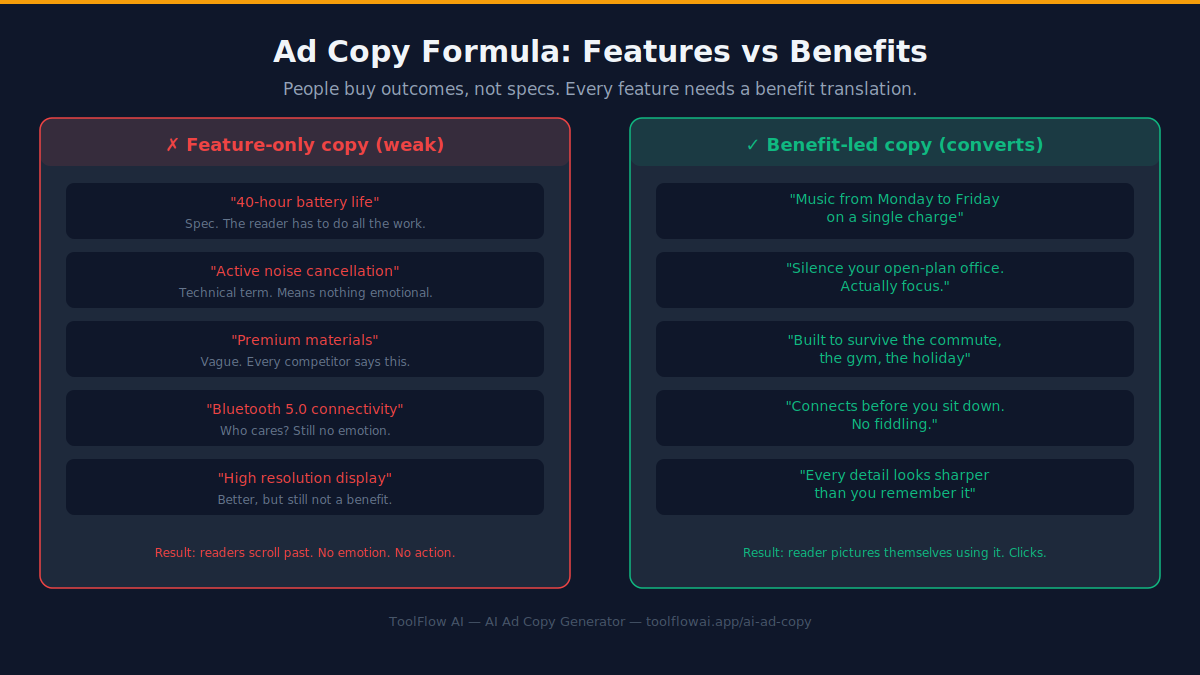
Features are facts about the product. Benefits are what those facts mean for the person reading your ad. People do not buy a 40-hour battery — they buy the ability to get through the entire working week without thinking about charging. People do not buy active noise cancellation — they buy silence in a noisy open-plan office.
For every feature in your product, ask: "so what does that mean for the buyer?" The answer is your benefit. Use the benefit in the ad. Mention the feature if it adds credibility to the benefit claim.
Writing for each platform
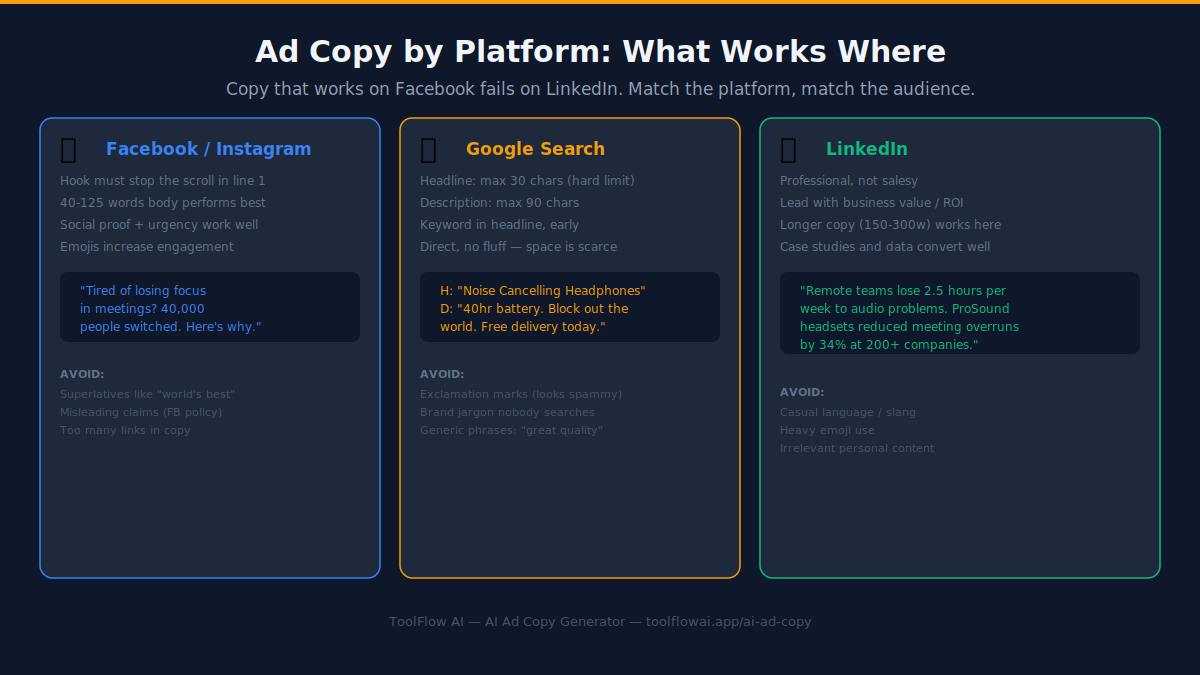
The same product needs different copy depending on where the ad appears:
- Facebook and Instagram — the hook (first 1-2 lines) is critical because text is truncated. Aim for 40-125 words in the body. Social proof ("40,000 customers") and urgency ("offer ends Sunday") both improve conversion. Avoid superlatives — Facebook may suppress ads with "world's best" language.
- Google Search — strict character limits: 30 characters per headline, 90 per description. Every word must earn its place. Lead with the keyword. Focus on the specific outcome the searcher is looking for.
- LinkedIn — your audience is professional and sceptical of pushy advertising. Lead with business value and data. Longer copy (150-300 words) often outperforms short copy because the audience reads more carefully. Case studies and specific ROI numbers convert well.
- TikTok — authenticity beats polish. The hook must land in 3 seconds. Casual, conversational language. The best TikTok ads feel like organic content, not advertisements.
The AI ad copy workflow
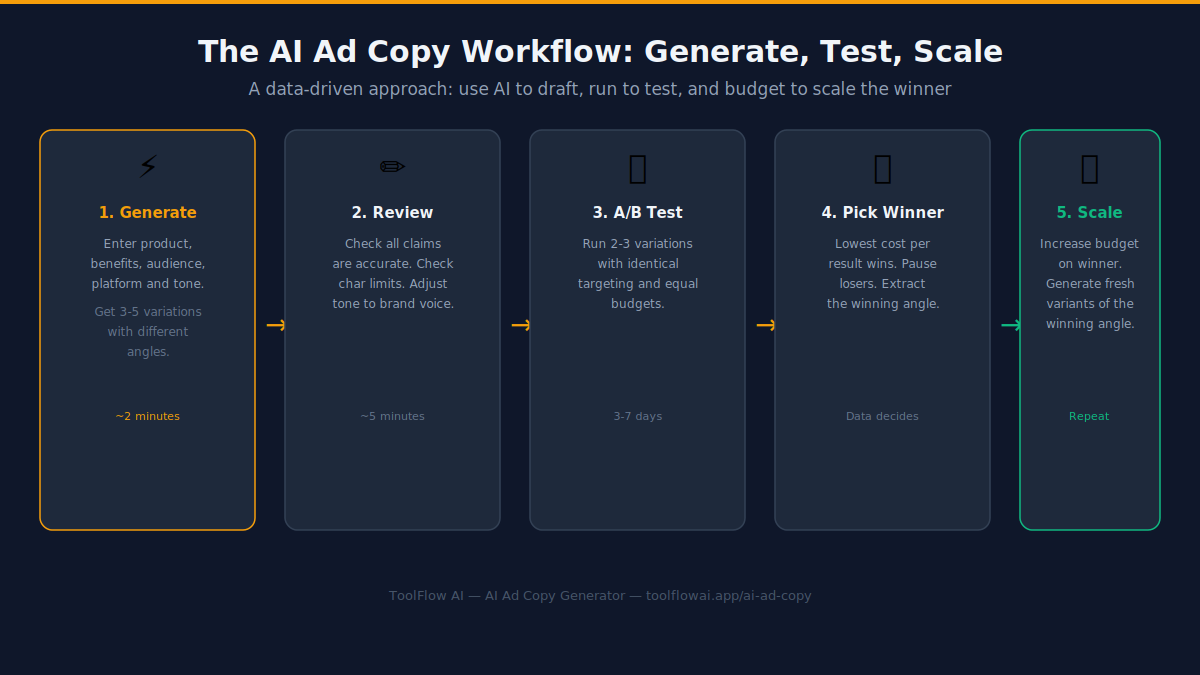
- Generate 3-5 variations — use the ToolFlow AI Ad Copy Generator to produce multiple angles in seconds. Each variation should test a different hook, benefit emphasis, or emotional angle.
- Review for accuracy — check every claim in the copy. AI can produce confident-sounding statements that are not accurate. Verify every figure, testimonial reference, and benefit claim before running.
- Run an A/B test — create separate ad sets with identical targeting and equal budgets. Run for 3-7 days minimum before drawing conclusions.
- Identify the winner — lowest cost per result wins, not highest click-through rate. CTR measures interest; cost per result measures revenue.
- Scale the winner — increase budget on the winning variation. Generate fresh variations of the winning angle to avoid ad fatigue.
Elements that consistently improve ad copy performance
- Specificity — "Save 3 hours a week" outperforms "save time". "4.8 stars from 12,000 reviews" outperforms "highly rated". Numbers and specifics signal credibility.
- One clear CTA — Shop now. Start your free trial. Get your quote. One ask per ad. Multiple CTAs split attention and reduce conversion.
- Social proof — customer counts, review ratings, named companies, media logos. Proof that others have taken the risk first reduces the perceived risk for the new buyer.
- Urgency or scarcity — "Ends Sunday", "Only 14 left", "Offer expires at midnight". When truthful, urgency significantly increases conversion rates.
- Pain point first — "Tired of losing focus in open-plan offices?" addresses the reader's problem before introducing the solution. Pain-first ads outperform product-first ads for cold audiences.
Generate ad copy — free, no signup
Product, benefits, platform, tone. Get 1-5 variations ready for A/B testing in seconds.
Frequently Asked Questions
How many ad variations should I test?
2-3 variations per test is the recommended range. Enough to find a winner without overcomplicating your ad set structure or splitting your budget too thinly to get statistically meaningful results. Once you have a winner, generate fresh variations of that winning angle rather than starting from scratch.
How long should I run an A/B test before deciding?
At least 3-5 days, ideally 7, and with enough conversions (50+ per variation) to be statistically meaningful. Cutting tests short because one variation looks better early is one of the most common and costly ad testing mistakes.
Should I edit the AI output before running?
Always. Review for factual accuracy, verify any specific claims, check character limits for your platform, and adjust the tone to match your brand voice. AI provides a strong starting draft — you provide accuracy and brand alignment.
Can I use these ads for a service rather than a product?
Yes — the tool works equally well for services, SaaS products, courses, events, and apps. Describe what your service does and the specific outcome it delivers, and the AI will write copy around that outcome rather than product features.
What is the difference between a hook and a headline?
On Facebook and Instagram, the hook is the first line of the body copy — the line visible before "more" is tapped. The headline is the bold text below the image in the ad unit. Both need to earn attention, but they serve slightly different functions: the headline names the product or offer, the hook creates curiosity or emotion in the body copy.