Most Instagram captions are an afterthought. The photo gets the attention, the caption gets whatever is left over. But your caption is doing real work: it signals to Instagram's algorithm what your content is about, it gives people a reason to save or comment, and it builds the voice that makes followers come back. Getting it right consistently is the difference between an account that grows and one that flatlines.
Free Ebook: 100 Instagram Caption Templates
How to Write Instagram Captions That Get Likes, Saves and Comments (2026)
Everything in this article — the hook formula, caption anatomy, hashtag strategy and 100 copy-and-paste templates — collected into one beautifully designed 57-page ebook. Read offline, print it out, or keep it open while you write.
- 100 copy-and-paste caption templates
- Hook formula for every content type
- Hashtag strategy (2+4+4 formula)
- AI prompt library
- Caption anatomy breakdown
- Printable A4 PDF
- Offline access
- Free forever
- No signup required
- Instant download
The anatomy of a high-performing caption
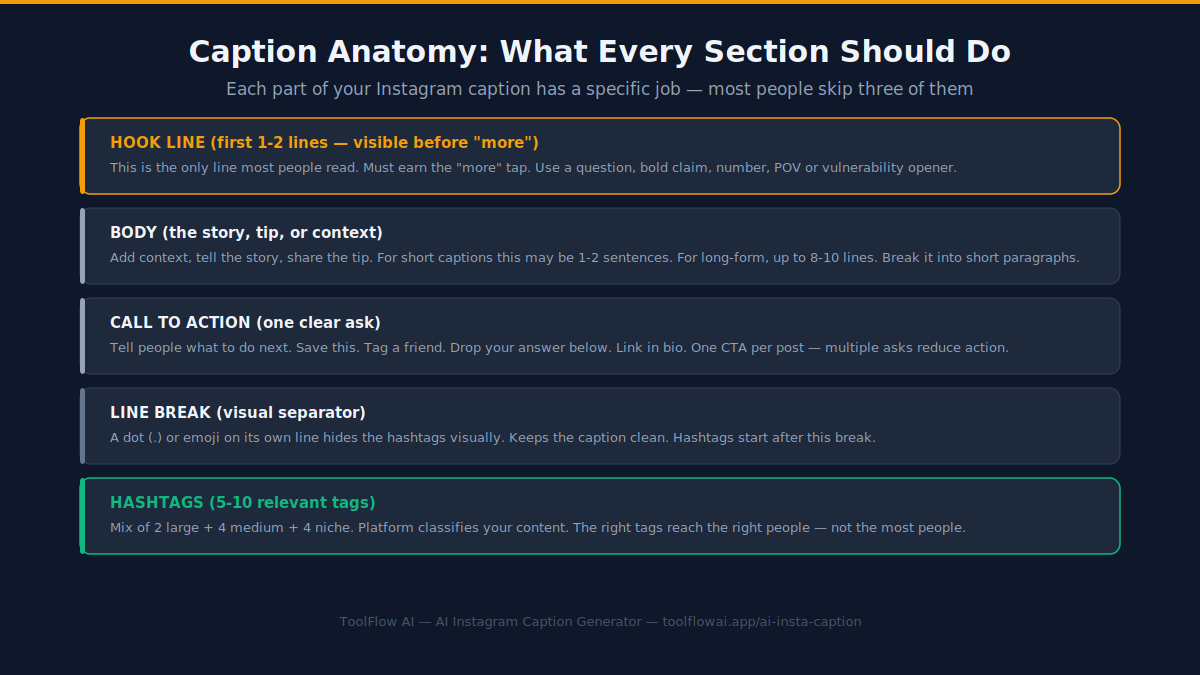
A caption that drives engagement has five parts, each with a specific function:
- Hook line — the first 1-2 lines visible before "more". This decides whether anyone reads the rest. It has to earn the tap.
- Body — the story, tip, context or emotion. Short captions can be one sentence. Long-form can run 8-10 lines.
- Call to action — one clear ask. Save this. Tag someone. Answer the question below. One CTA, not three.
- Visual separator — a dot or emoji on its own line to visually hide the hashtag block from the caption.
- Hashtags — 5-10 targeted tags that help Instagram classify your content and serve it to the right audience.
5 opening lines that stop the scroll
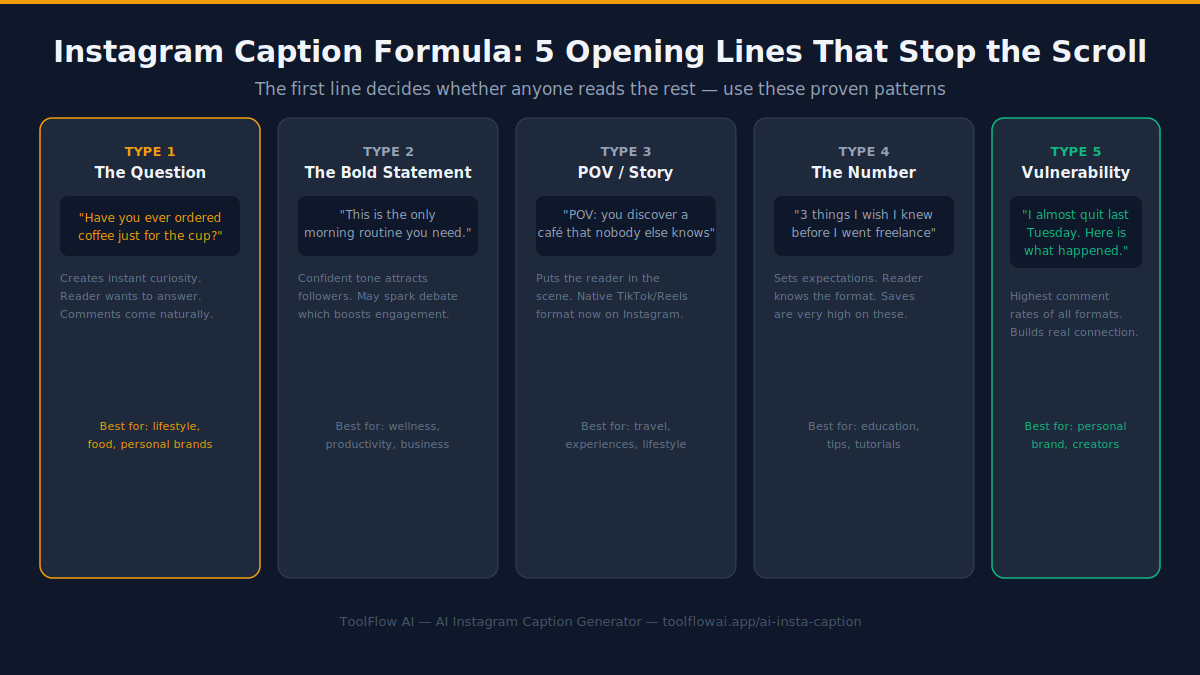
The hook line is the most important sentence you will write. Instagram shows roughly 125 characters before truncating with "more" — that is about two short lines. Here are five patterns that consistently earn the tap:
- The question — "Have you ever ordered coffee just for the cup?" Creates curiosity and invites comments naturally. Best for lifestyle, food, and personal brands.
- The bold statement — "This is the only morning routine you need." Confident tone attracts followers and may spark debate, which boosts engagement signals. Best for wellness, productivity, and business content.
- POV / story opener — "POV: you discover a café nobody else knows about." Places the reader in the scene. Native to Reels and now performing well on regular posts. Best for travel and experiences.
- The number — "3 things I wish I knew before going freelance." Sets clear expectations. Readers know exactly what they are getting. Saves rates are very high on numbered tip posts.
- Vulnerability — "I almost quit last Tuesday. Here is what happened." Has the highest comment rates of any caption format. Builds genuine connection. Best for personal brands and creators.
Instagram hashtag strategy in 2026
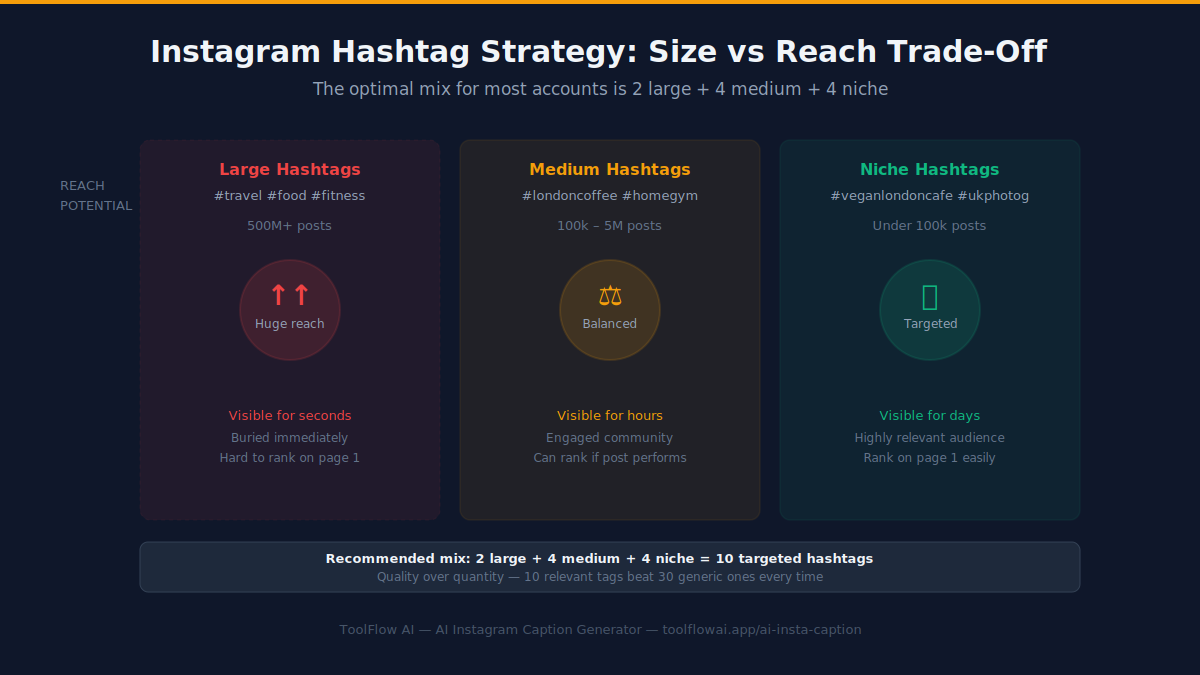
The conventional wisdom — "use 30 hashtags" — is outdated. Instagram has confirmed that relevance matters far more than quantity. The optimal approach:
- 2 large hashtags (500k–50M posts) — broad exposure, you will be buried quickly but algorithm sees the context
- 4 medium hashtags (100k–5M posts) — engaged communities, visible for hours, good chance of ranking on the recent page
- 4 niche hashtags (under 100k posts) — highly relevant audience, you can stay on the first page for days
Total: 10 targeted hashtags beats 30 generic ones every time. Rotate your sets across posts — using identical hashtags on every post may suppress reach over time.
Caption length: which to use when
- Short (1-2 lines) — for visually strong posts where the image speaks for itself. Fashion, architecture, product photography. Let the photo lead.
- Medium (3-5 lines) — the most versatile length for most content types. Enough to add personality without losing readers.
- Long (6+ lines) — for carousels, tutorials, personal milestones, or storytelling. The caption becomes part of the content, not just a label for it.
Generate Instagram captions with AI
Rather than writing from scratch every time, the ToolFlow AI Instagram Caption Generator produces multiple caption options in seconds. Describe your post, choose your vibe (casual, funny, aesthetic, motivational) and account type, and get 1, 3 or 5 caption variations — each with hashtags, emojis, and a CTA built in. Pick the best one or combine elements from multiple outputs.
Generate Instagram captions — free
Describe your post, choose your vibe. Get 1-5 caption options with hashtags in seconds.
Frequently Asked Questions
Do hashtags still work on Instagram in 2026?
Yes, but differently than before. Instagram uses hashtags to classify content and show it to interested audiences — not just to people who follow a hashtag. 5-10 highly relevant tags consistently outperform 25-30 generic ones. Niche hashtags where you can rank on the first page are more valuable than enormous tags where you disappear in seconds.
Should I put hashtags in the caption or first comment?
Both approaches work equally well algorithmically. Putting them in the first comment keeps the caption visually clean. Putting them in the caption (after a visual separator) is simpler to manage. Choose based on your aesthetic preference.
How long should an Instagram caption be?
Instagram allows up to 2,200 characters. The right length depends on your content: short and punchy for strong visual posts, longer and more narrative for educational or personal content. The only hard rule is that the first 125 characters must earn the "more" tap.
Why are my captions getting low engagement?
The most common causes: a weak hook that does not earn the tap, no call to action telling people what to do, overly generic hashtags with hundreds of millions of posts, or a tone that feels like marketing rather than conversation. Try the 5 hook patterns above and rotate your hashtag sets.
Can I generate captions in other languages?
Yes — describe your post in English and specify the target language (e.g. "Write in Spanish: a photo of my morning coffee routine in Barcelona") and the AI will generate captions in that language with appropriate hashtags.
Free Ebook: 100 Instagram Caption Templates
How to Write Instagram Captions That Get Likes, Saves and Comments (2026)
The complete caption writing guide in one offline-ready PDF — hook formulas, 100 templates, hashtag strategy and AI prompts included.
Free · No signup · Instant download · 57 pages