Most product descriptions fail in one of two ways: they are either so vague ("premium quality, great value") that they mean nothing to anyone, or they are a dry list of specs with no emotional hook. Neither approach answers the question the buyer is actually asking: "Will this product make my life better, and if so, how exactly?" The best product descriptions answer that question specifically, for a specific person, in language that makes them picture themselves already using it.
Weak vs strong: what the difference looks like
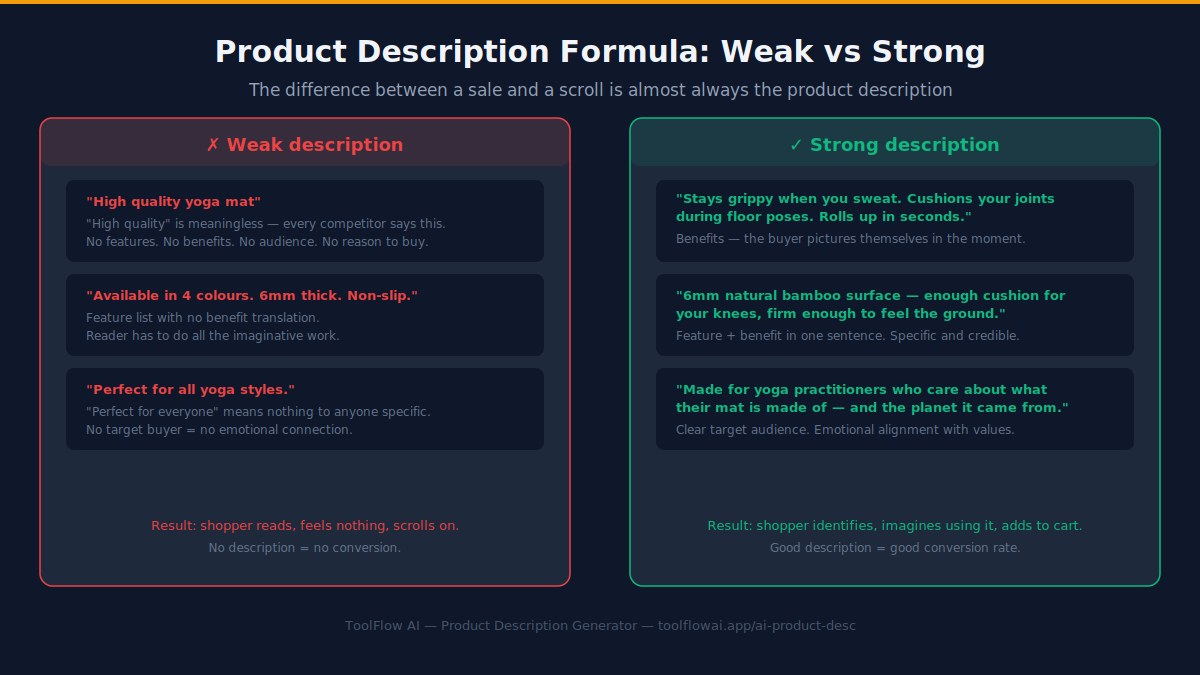
Compare these two approaches for the same yoga mat. The weak version: "High quality yoga mat. Available in 4 colours. 6mm thick. Non-slip. Perfect for all yoga styles." The strong version: "Stays grippy when you sweat. Cushions your joints during floor poses. 6mm natural bamboo surface — firm enough to feel the ground, soft enough to protect your knees. Made for yoga practitioners who care about what their mat is made of."
The first version describes a product sitting on a shelf. The second puts the buyer in the moment of using it. Every specific detail ("stays grippy when you sweat") is something the target buyer has thought about and worried about. Addressing it removes the objection before it arises.
The 5-part product description formula
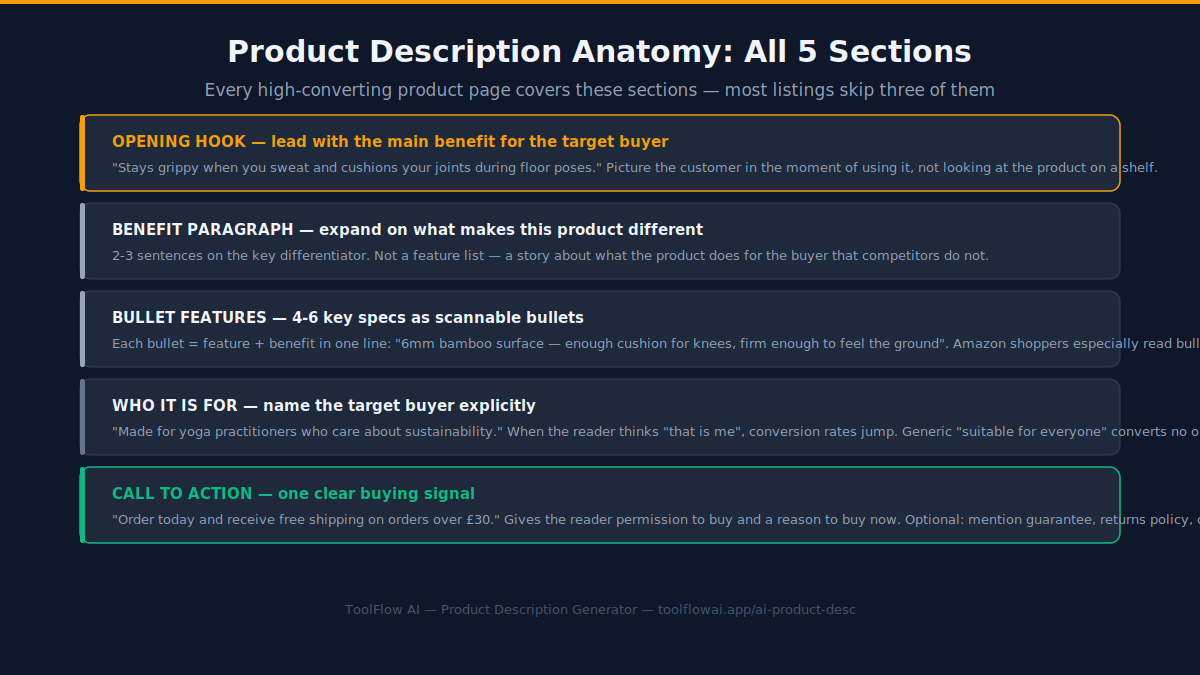
- Opening hook — lead with the main benefit for the target buyer, not the product name or a generic claim. Put the reader in the moment of using the product.
- Benefit paragraph — 2-3 sentences on what makes this product different from alternatives. Not a feature list — a story about the outcome the buyer gets.
- Bullet features — 4-6 key specs, each written as feature + benefit in one line. Amazon shoppers especially read bullet points before body copy.
- Who it is for — name the target buyer explicitly. "Made for yoga practitioners who care about sustainability." When the reader thinks "that is me", conversion rates jump significantly.
- Call to action — a short buying signal with an optional reason to act now. "Order today with free shipping on orders over £30."
Platform-specific rules
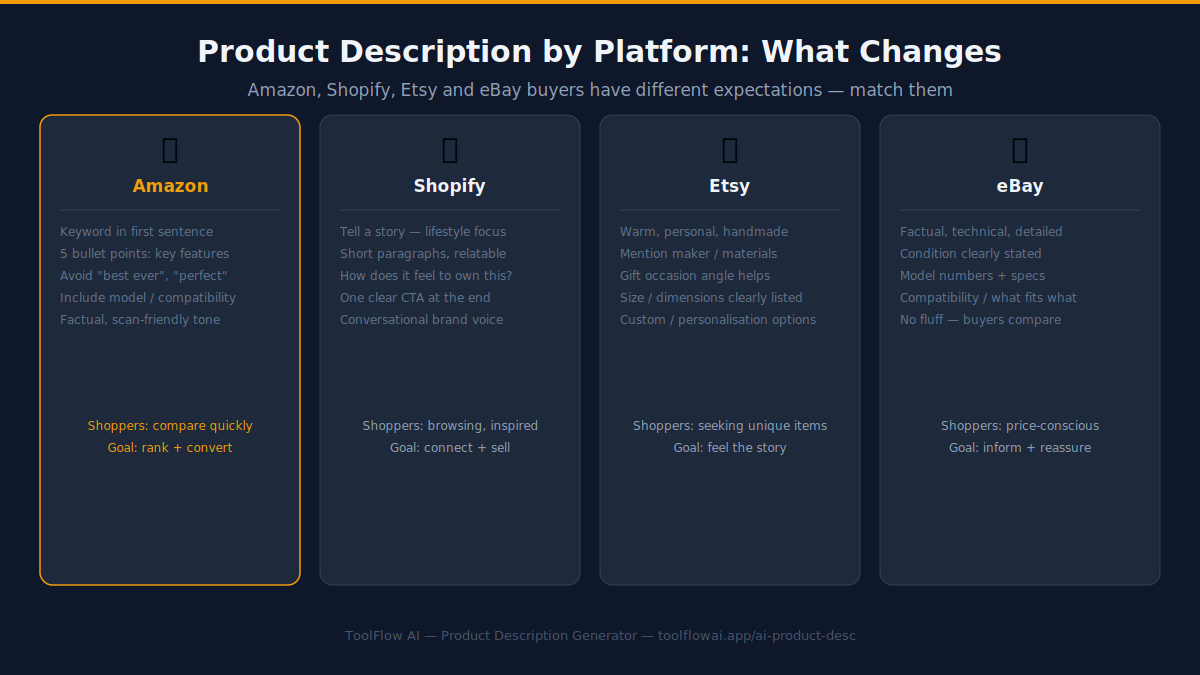
The tone, structure, and priorities of your product description should change depending on the platform:
- Amazon — keyword in the first sentence (for search ranking), five bullet points covering the key features, factual and scannable tone. Avoid superlatives like "world's best" — Amazon may suppress listings that use them.
- Shopify — lifestyle-focused storytelling. Short paragraphs. Help the buyer imagine owning the product and how it changes their day. One clear CTA at the end.
- Etsy — warm, personal, and handmade in feel. Mention materials, the maker, and any custom or personalisation options. Include gift-giving occasions where relevant. List dimensions clearly.
- eBay — factual and detailed. State condition clearly. Include model numbers, compatibility, and technical specs. Buyers compare listings side by side and are price-sensitive.
How to generate product descriptions with AI
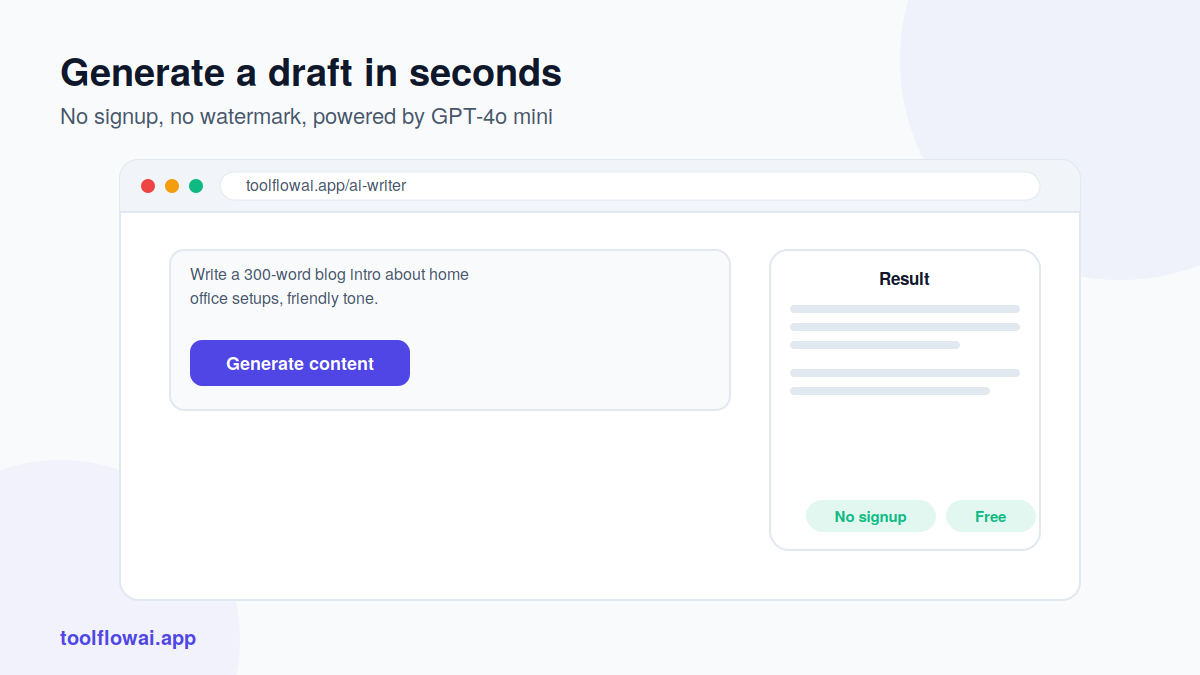
The ToolFlow AI Product Description Generator produces platform-matched, tone-matched descriptions in seconds. Enter your product name, list the key features and specs, describe your target customer, choose the platform and tone, and click Generate.
The tool applies platform-specific rules automatically — Amazon descriptions are keyword-first with scannable bullets, Shopify descriptions use lifestyle language, Etsy descriptions feel warm and personal. You can generate 1 description or 3 variations to compare different angles.
The features field is the most important input
The quality of the generated description depends almost entirely on what you put in the features and benefits field. "Yoga mat, non-slip" produces a generic description. "6mm natural bamboo surface, non-slip bottom tested to 800kg friction force, 183cm x 61cm, carry strap included, vegan and allergen-free materials certified, 30-day returns" produces a specific, credible, useful description.
Include both features (what the product is) and benefits (what the product does for the buyer). The more specific and real your inputs, the more specific and useful the AI output.
Generate your product description — free
Amazon, Shopify, Etsy, eBay. Choose your platform, tone and length. Results in seconds.
Frequently Asked Questions
How long should a product description be?
It depends on the platform and product complexity. Short (50-80 words) works for simple, commodity products. Medium (100-150 words) suits most e-commerce products. Long (200-250 words) is appropriate for premium, complex, or lifestyle products where the story matters. On Amazon, the bullet points often matter more than the body copy length.
Should I use the AI output directly without editing?
Review it first. Check all specifications are accurate, confirm the tone matches your brand, and verify it fits your platform's character limits. AI occasionally rephrases specs in a way that sounds compelling but should be verified. The output is a strong first draft, not a final product.
What is the most common mistake in product descriptions?
Writing for the product rather than for the buyer. Features describe the product. Benefits describe what the product does for the person reading. Every feature should be translated into a benefit — and the most important benefit should be in the first sentence.
Does this work for digital products and services?
Yes — describe what the digital product includes, its format, who it is for, and what outcome it delivers. The generator works for SaaS products, courses, templates, ebooks, and service packages, not just physical goods.
How do I write a product description for SEO on Amazon?
Include your primary search keyword in the first sentence of the body copy and in at least two of the five bullet points. Use secondary keywords naturally throughout. Enable the SEO keywords option in the generator — it will list the key terms used at the end of the description for reference. Avoid keyword stuffing; Amazon's algorithm rewards natural usage.
Can I generate descriptions in other languages?
Yes — add your target language to the product description field (e.g. "Write in French: a yoga mat made from…") and the description will be generated in that language with appropriate localisation.