The average Instagram user scrolls through 300 feet of content every day. Your caption has about half a second to earn the tap before someone keeps scrolling. Most accounts post a mediocre caption as an afterthought — and wonder why engagement is flat. This guide gives you 100 ready-to-use caption templates grouped by type, a caption formula that works for any niche, a hashtag strategy based on how the algorithm actually works in 2026, and a pre-post checklist that takes 60 seconds but saves you from the most common mistakes.
Download the Free Ebook
100 Instagram Caption Templates That Get Likes, Saves and Comments (2026)
Take the complete ToolFlow guide with you. Download the professionally designed ebook containing all 100 caption templates, hook formulas, hashtag strategy, AI prompts and bonus tips. Read it offline, print it, or keep it open while creating content.
- 57-page professionally designed ebook
- 100 copy-and-paste caption templates
- Hook formulas included
- Hashtag strategy
- AI prompt library
- Printable A4 PDF
- Offline access
- Free forever
- No signup required
- Instant download
Every template uses square brackets for the parts you fill in. Read the template aloud, replace the brackets, and you have a caption in under two minutes. If you want multiple variations instantly, the ToolFlow AI Instagram Caption Generator produces a complete caption — hook, body, CTA and hashtags — from a one-line description of your post.
The anatomy of a high-performing caption
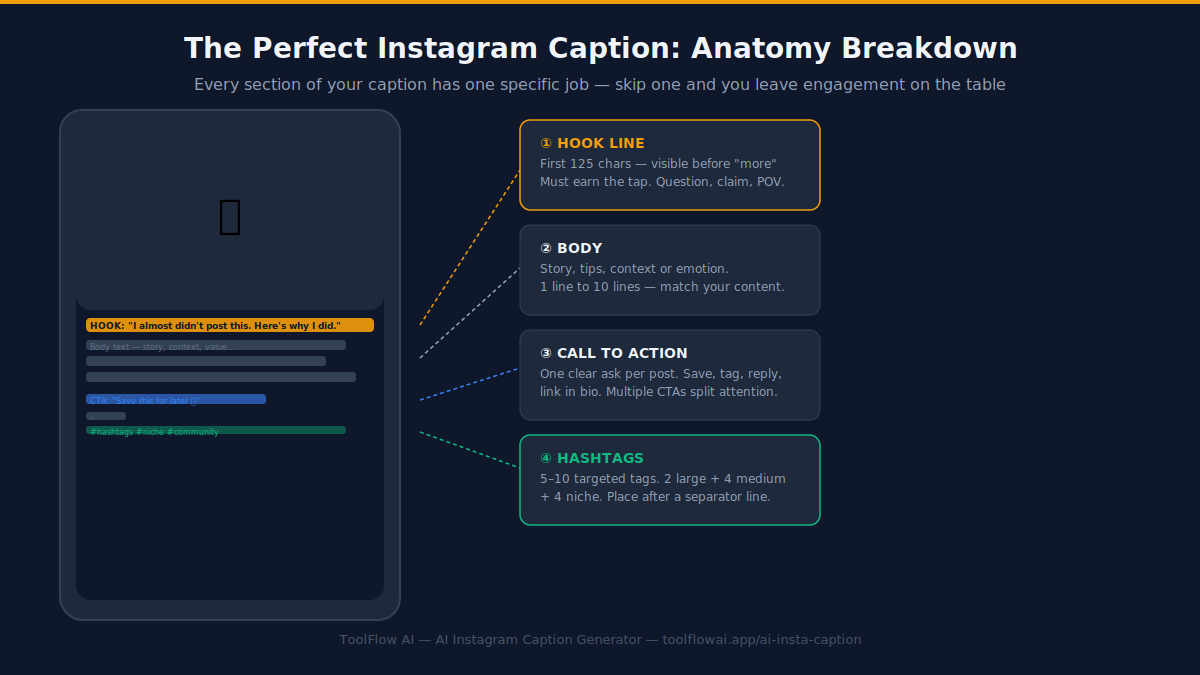
Every caption that earns saves, comments and shares has four parts:
- Hook line — the first 125 characters visible before "more". This is the only line most people read. It must interrupt the scroll.
- Body — the story, tip, list, or emotion. Can be one sentence or ten lines depending on the content type.
- Call to action — one specific ask. Save this, tag a friend, comment below, link in bio. One CTA, not three.
- Hashtags — placed after a visual separator (a dot on its own line). 5–10 targeted tags, not 30 generic ones.
10 hook types that stop the scroll
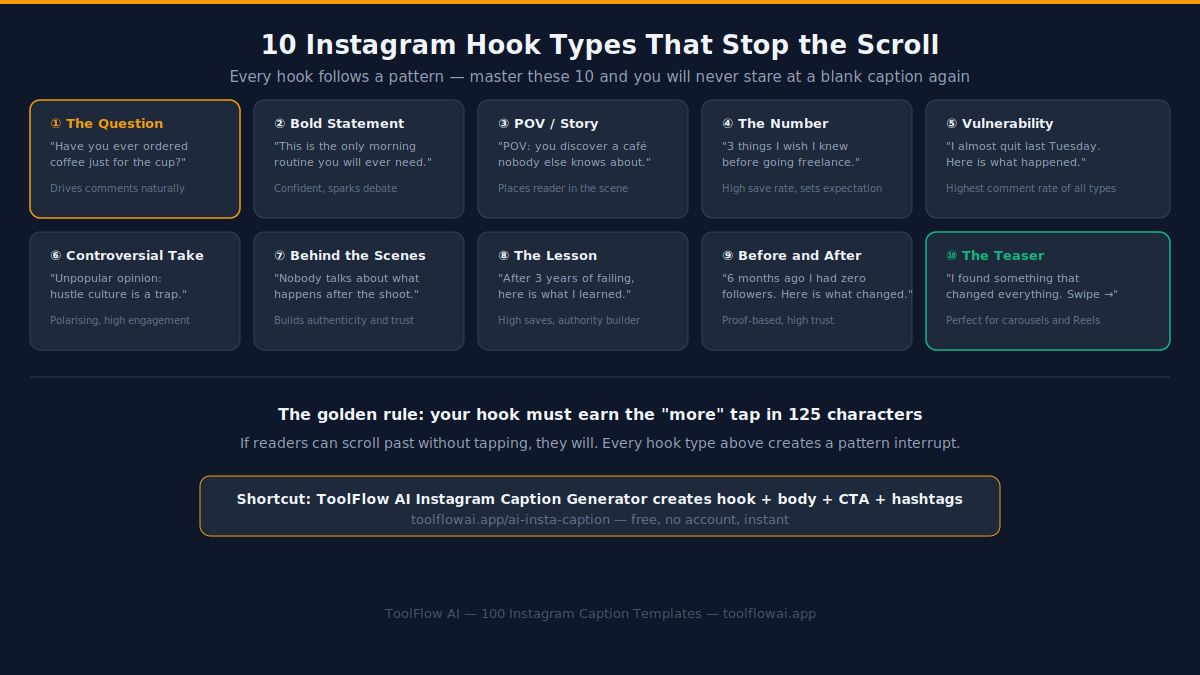
These are the 10 patterns that consistently earn the "more" tap across all niches. Every template in the section below falls into one of these categories.
① The Question
Creates curiosity and drives comments naturally. The reader feels compelled to answer. Best for lifestyle, food, personal brands, and travel.
Example: "Have you ever ordered a coffee just for the cup?"
② The Bold Statement
A confident, singular claim. Works because it takes a clear position — something most accounts avoid. May spark debate, which boosts algorithmic distribution.
Example: "This is the only morning routine you will ever need."
③ The POV / Story Opener
Places the reader inside a scene before the "more" tap. Native to Reels and short-form video, now performing well on standard posts too.
Example: "POV: you discover a café nobody else knows about."
④ The Number
Sets clear expectations. The reader knows exactly what they are getting. Number posts consistently earn high saves.
Example: "3 things I wish I knew before going freelance."
⑤ Vulnerability
The highest comment rate of any hook type. Builds genuine human connection. Risky to do poorly but powerful when done authentically.
Example: "I almost quit last Tuesday. Here is what happened."
⑥ The Controversial Take
Opens with an opinion that not everyone agrees with. Generates high engagement because it invites disagreement and conversation.
Example: "Unpopular opinion: hustle culture is destroying creativity."
⑦ Behind the Scenes
Reveals what the audience does not normally see. Drives trust and authenticity, especially for creators and businesses.
Example: "Nobody talks about what happens after the photoshoot."
⑧ The Lesson
Opens with a promise of hard-earned insight. High save rates because readers want to return to it later.
Example: "After 3 years of failing at this, here is what I actually learned."
⑨ Before and After
Uses a transformation as the hook. Proof-based and highly credible. Works for fitness, business, design, cooking, and personal development.
Example: "6 months ago I had zero followers. Here is what changed."
⑩ The Teaser
Creates deliberate curiosity with a partial reveal. Perfect for carousels, Reels, and multi-image posts where the payoff is in the swipe.
Example: "I found something that completely changed how I work. Swipe to see it →"
100 Instagram caption templates by category
Every template uses [brackets] for your fill-in. Read it aloud, personalise the bracketed parts, and post. The templates are grouped into 10 categories of 10 — find the one that matches your content type.
Category 1: Motivational and mindset (10 templates)
- "The moment I stopped [doing X], everything changed. Here is what I did instead."
- "Nobody told me [difficult truth about your niche]. I had to find that out myself."
- "If you are struggling with [common pain point], you are not alone. This is what helped me."
- "The biggest lie I believed about [topic] was [belief]. Here is the truth."
- "A year ago I was [previous state]. Today I am [current state]. The difference? [one thing]."
- "Stop waiting for [common excuse]. The [result] you want will not come from [wrong action]."
- "[Number] percent of people quit [activity] before they see results. Here is why you should not be one of them."
- "The most important thing I learned from [experience or person] was this: [lesson in one sentence]."
- "You do not need to [common misconception]. You need to [simple alternative]."
- "Hard truth: [unpopular opinion about your niche]. Save this for the day you need it."
Category 2: Lifestyle and daily life (10 templates)
- "Current vibe: [mood or activity] and pretending I have my life together."
- "Things that are living rent-free in my head this week: [list 3 things]."
- "The part nobody posts about: [honest mundane truth about your life or work]."
- "My [day/morning/evening] routine, unfiltered: [brief honest description]."
- "Hot take: [opinion about something mundane in your daily life]."
- "If your week looked like mine it would include [3 relatable things]. How was yours?"
- "Permission to [do something people feel guilty about]. You are welcome."
- "POV: it is [time or day] and you are [relatable scenario your audience will recognise]."
- "I did not plan to [spontaneous decision]. I do not regret it."
- "The most [adjective] part of my [day/week/project] was [unexpected honest answer]."
Category 3: Food and drink (10 templates)
- "I made [dish] three times this week. Here is the version that finally worked: [brief tip or recipe]."
- "The only [food or drink] recipe you need this [season]. Saving this for later? You should."
- "[Restaurant or place] never disappoints. The [specific dish] is [specific observation]. Go."
- "Controversial: [unpopular food opinion]. Fight me in the comments."
- "Hot girl [activity] is actually [relatable food-related habit]. No I will not elaborate."
- "What I eat in a day when I am being [honest adjective]: [brief truthful description]."
- "The secret ingredient in this [dish] is [surprising thing]. Tag someone who would never guess it."
- "I used to think [common food misconception]. Then I tried [specific thing] and everything changed."
- "Rating: [food or drink] — [creative scoring out of 10 with a unique metric]."
- "If you are not [specific food preparation technique], you are missing out. Here is why."
Category 4: Travel and places (10 templates)
- "[Place] was not on my list. Then [thing that happened]. Now it is at the top."
- "Everything they say about [destination] is [true/wrong/complicated]. Here is what nobody mentions."
- "The best [thing] I found in [place] was not on any travel blog. It was [unexpected discovery]."
- "I spent [number] days in [place]. Here are the [number] things I would do differently."
- "Solo in [place]. The most memorable moment was [honest unexpected experience]."
- "[Place] bucket list item: [specific experience]. Worth every [penny/hour of travel]."
- "The thing about travelling to [place] that nobody prepares you for: [honest observation]."
- "Back from [place]. Still thinking about [specific thing — food, view, person, experience]."
- "You do not need [common travel luxury] to enjoy [destination]. You need [simpler thing]."
- "Why does [place] feel like [unexpected emotional description]? It caught me off guard."
Category 5: Business and entrepreneurship (10 templates)
- "[Number] lessons from my first [milestone] in business that I wish someone had told me earlier."
- "The thing that finally made [business task] click for me was [specific insight or tool]."
- "I turned down [opportunity] last month. Here is why that was the right call."
- "Real talk about [common business topic]: it is not what the [course/guru/book] says it is."
- "How I [achieved result] in [timeframe] without [common assumption about how it is done]."
- "The [tool/system/habit] that changed how I run my business: [specific thing]. Details below."
- "Starting [business type]? Do [specific action] before anything else. I did not and it cost me [consequence]."
- "My [number]-step process for [common business task] — the version that actually works."
- "What [business milestone] actually feels like vs what I thought it would feel like."
- "Save this: everything you need to know about [business topic] in [number] bullet points."
Category 6: Fitness and wellness (10 templates)
- "[Number] weeks of [workout or habit]. Here is what changed — and what did not."
- "The fitness advice I wish I had ignored: [common bad advice]. What actually worked: [honest alternative]."
- "Not every workout will be your best. Today was [honest description]. Showed up anyway."
- "My [morning/evening] wellness routine took [timeframe] to build. The non-negotiable is [specific habit]."
- "[Exercise or habit] before and after: [honest comparison that is not about appearance]."
- "Rest days used to feel like failure. Now I know [mindset shift]. Here is what changed."
- "The [workout/habit] that nobody in my feed was talking about that completely transformed my [result]."
- "[Number] things I stopped doing at the gym and the results surprised me."
- "Your [exercise or wellness goal] does not require [common expensive or complicated thing]. You just need [simpler truth]."
- "Honest wellness check-in: [one thing going well], [one thing still hard], [one thing you are working on]. Drop yours below."
Category 7: Fashion and beauty (10 templates)
- "This [item] cost [price] and has been [frequency of use]. Best [money value] of my life."
- "The [product or item] I kept seeing everywhere and finally tried: [honest verdict]."
- "Outfit formula that always works for me: [brief repeatable combination]. Save this."
- "[Trend] is [your honest take]. Here is what I wear instead and why."
- "I used to spend [amount or time] on [beauty routine]. Then I switched to [simpler thing]. Here is the result."
- "[Number] items I wear on repeat because [honest reason, not just aesthetics]."
- "The [beauty product] review I wish existed before I bought [expensive mistake]: [your honest take]."
- "Getting dressed when you do not feel like it: [honest description of the compromise outfit]."
- "[Skin/hair/body] tip that changed everything for me: [specific actionable advice]."
- "I dressed for [mood or situation] today. The result: [description of the look]."
Category 8: Creativity and art (10 templates)
- "I made this during [emotional or mental state]. Sometimes the work reflects the process."
- "[Number] things nobody tells you about being a creative: [honest list]."
- "The piece I almost did not finish — and why I am glad I pushed through."
- "How I went from [starting point] to [result]: the creative process, unfiltered."
- "Creative block hit hard this [week/month]. Here is what eventually got me unstuck: [specific thing]."
- "Sharing the [work] I made for myself, not for the algorithm. Hope it lands."
- "[Number] creative tools and resources I use every week that I never see anyone else talking about."
- "The hardest part of [creative discipline] is not [what most people think]. It is [honest answer]."
- "Made this in [timeframe]. If you make things, you know exactly what [specific emotion] feels like at [stage of the process]."
- "Throwback to when I made [early work] and thought it was good. Grateful for the growth."
Category 9: Educational and how-to (10 templates)
- "[Number] things you need to know about [topic] before you [action]. Save this."
- "The [topic] guide I wish I had when I was starting out. Sharing everything I know."
- "How to [desired outcome] in [timeframe] without [common obstacle]. Step by step:"
- "Quick [topic] tip that took me [timeframe] to figure out: [specific actionable insight]."
- "Everything I know about [topic] in one post. Bookmark this for later."
- "[Topic] explained simply: [one-sentence summary]. More detail in the caption."
- "The [topic] mistake I made so you do not have to: [specific mistake and what you learned]."
- "If you only do [number] things to improve your [topic], make them these: [brief list]."
- "[Topic] cheat sheet — the [number] rules that matter and the [number] you can ignore."
- "Nobody explains [topic] like this. Sharing the version I wish someone had given me."
Category 10: Product and brand promotion (10 templates)
- "We made [product] because [honest reason — a problem you personally had]. Here is what makes it different."
- "[Number] ways our customers are using [product] that we never expected. The [number] one surprised us most."
- "The most common question we get about [product] is [question]. The honest answer: [genuine response]."
- "Before [product], our customers told us [pain point]. After: [specific outcome]. That is why we do this."
- "We are [doing something notable — restocking, launching, changing something]. Here is what you need to know."
- "What goes into making [product] that nobody sees: [behind-the-scenes insight]."
- "[Customer name or @handle] said [genuine customer quote about the product]. This is why we show up every day."
- "Limited to [quantity]. [Product] is [adjective that honestly describes it]. Link in bio when it drops."
- "If [product] were a [unexpected comparison], it would be [witty or surprising answer]. Introducing [product name]."
- "The problem with [common alternative to your product]: [honest critique]. How we fixed it: [specific differentiator]."
Hashtag strategy that still works in 2026
Instagram's algorithm has changed significantly, but hashtags still serve one key function: they help Instagram classify your content and serve it to people who do not already follow you. Here is the approach that currently produces the best results.
The 2+4+4 formula
- 2 large hashtags (500k–50M posts) — broad context signal. Your post will not stay visible long in these, but the algorithm uses them to understand your content category. Examples: #photography, #marketingtips, #veganfood.
- 4 medium hashtags (50k–500k posts) — active communities with manageable competition. Posts can stay visible for hours. Examples: #londonphotographer, #smallbizmarketing, #veganlondon.
- 4 niche hashtags (under 50k posts) — this is where most growth happens for smaller accounts. Competition is low, relevance is high, and your post can stay on the first page for days. Examples: #hackneycafes, #southlondonfood, #ukveganphotographer.
Finding niche hashtags that actually work
Search a broad hashtag on Instagram, then look at the Related section for smaller variations. Search your city or region combined with your category. Look at what hashtags your top-performing competitors use on their most engaged posts — not their most recent, their most engaged.
Where to put your hashtags
Both positions — in the caption and in the first comment — perform identically from an algorithmic standpoint. Choose based on aesthetics. If you want a clean caption, use a dot (or an emoji) on its own line as a separator, then list hashtags below it. The separator hides them from the preview without moving them to a separate comment.
The pre-post caption checklist
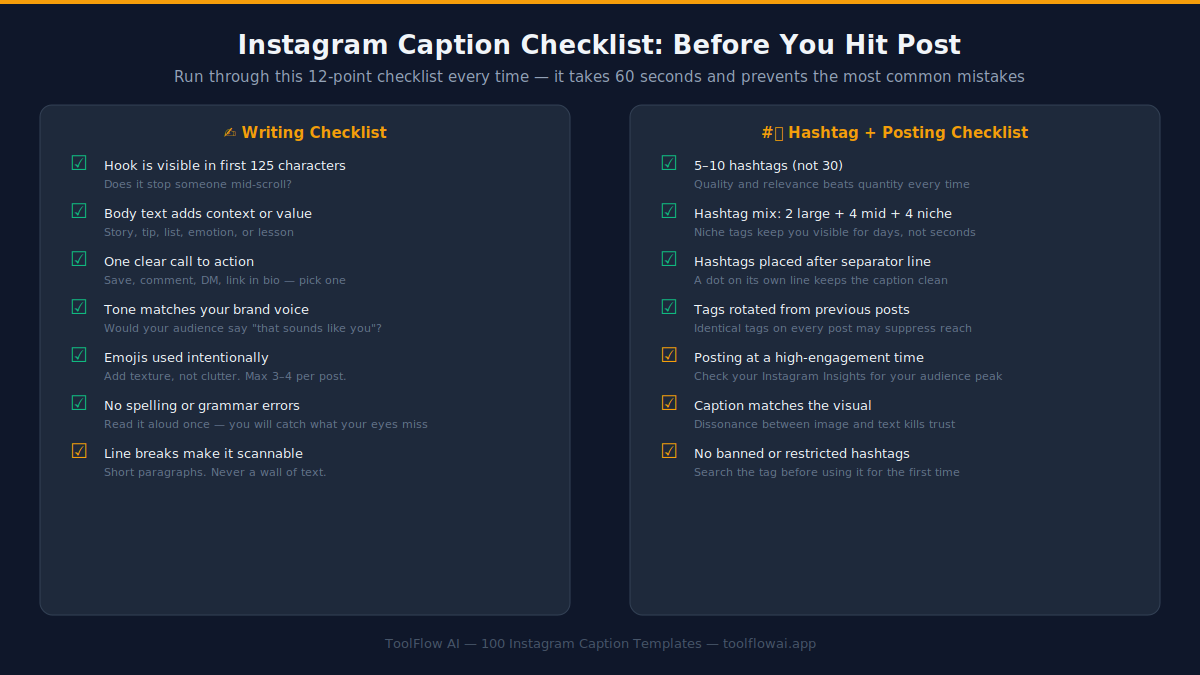
Writing checklist
- Hook is strong enough to earn the "more" tap in 125 characters
- Body text adds genuine value — story, lesson, tip, or emotion
- One clear call to action (not three)
- Tone matches your brand voice consistently
- Emojis are intentional, not decorative clutter (max 3–4)
- Read aloud once to catch errors your eyes skip
- Short paragraphs and line breaks — no walls of text
Hashtag and posting checklist
- 5–10 hashtags, not 30
- Mix of 2 large + 4 medium + 4 niche
- Tags placed after a visual separator line
- Tags rotated from previous posts
- Posted during a high-engagement window for your audience (check Insights)
- Caption matches what is actually in the visual
- No banned or restricted hashtags (search each one before first use)
Caption length guide by content type
There is no universally correct caption length. The right length depends on the content type and what the post is asking the audience to do.
| Content type | Ideal length | Why |
|---|---|---|
| Strong visual post (product, art, landscape) | 1–3 lines | The image does the work. Caption adds context, not competition. |
| Lifestyle, daily life, relatable content | 3–6 lines | Enough to add personality without losing readers mid-caption. |
| Educational, how-to, tip post | 6–12 lines | The value is in the detail. Readers opt into reading the full caption. |
| Personal story or vulnerability post | 8–15 lines | Story needs room to land. Highest-comment posts are often long. |
| Product or brand post | 3–8 lines | Lead with the benefit, not the feature. Short, clear CTA at the end. |
| Carousel post (swipeable) | 3–6 lines | The hook earns the swipe. Content is in the slides, not the caption. |
10 common Instagram caption mistakes
These are the errors that consistently suppress reach, reduce saves, and make followers scroll past even good content.
- Writing a weak hook — starting with "So…", "Today I…", or your brand name. None of these interrupt a scroll. Start with the most interesting thing you have to say.
- Multiple calls to action — "Like this, save it, share it, comment below, and visit the link in our bio." Every added CTA reduces the chance of any single action being taken. Pick one.
- Posting 30 random hashtags — using the maximum number of broad, unrelated tags signals spam to the algorithm. 5–10 relevant tags outperform 30 generic ones consistently.
- Walls of unbroken text — Instagram captions have no automatic paragraph spacing. You have to add line breaks manually. A wall of text gets scrolled past. Short paragraphs get read.
- Making it about the business, not the reader — "We are so excited to announce…" is about you. "Here is what this means for you…" is about them. The reader always asks: what is in this for me?
- Repeating identical hashtags on every post — this appears to signal to Instagram that the tags are being used as spam rather than as genuine content classification. Rotate sets.
- Captions that do not match the visual — if the photo is a beach sunset and the caption is a business lesson, audiences feel cognitive dissonance. The best captions grow naturally from the image.
- Generic CTAs — "Let me know what you think in the comments!" gives the reader no specific direction. "Which of these three options would you pick? Drop your answer below." is specific and easier to respond to.
- Over-hashtagging in the caption body — placing hashtags mid-sentence disrupts reading flow and looks amateur. Keep all tags together at the end after a separator.
- Posting without proofreading aloud — reading silently misses errors your brain autocorrects. Read it aloud once and you will catch them.
Non-obvious caption tips that actually move the needle
- The "save bait" structure — posts explicitly designed for saves ("Save this for when you need it", "Bookmark this before you need it", "Save this — you will thank yourself later") get significantly more saves than posts that just happen to be useful. The algorithm weights saves heavily.
- Respond to every comment in the first hour — the first 60 minutes after posting are disproportionately important. Every comment you receive and respond to in that window signals to Instagram that the post is generating engagement, which pushes it to more people.
- End your hook with a line break — before the "more" truncation, add a line break. It creates visual suspense and makes the "more" tap feel natural.
- Ask one specific question, not an open-ended one — "What do you think?" is too broad. "Would you try this or skip it?" gives people two easy options and comment rates go up substantially.
- Reference the image in the caption — "The look on my face in photo 3 tells the whole story" encourages swipes on a carousel. More swipe-through = stronger performance signal to the algorithm.
- Use the first comment strategically — after posting, leave a first comment immediately that adds extra context, asks a question, or drops a useful link. First comments appear prominently and get high engagement.
- Write captions before you take photos, not after — when you plan the story before the shoot, the photo and caption are aligned from the start. When you write the caption after, you are trying to force a story onto an image that may not support it.
- Test your hook in a story poll first — post two different hook options in a Stories poll: "Which would you read: A or B?" Your audience tells you which one wins before you commit to it in a feed post.
How to use AI to generate Instagram captions
The ToolFlow AI Instagram Caption Generator produces a complete caption in seconds from a one-line description of your post. Describe the photo or video, choose your vibe (casual, funny, inspirational, aesthetic, educational), select your account type and caption length, and specify whether to include hashtags and emojis. Get 1, 3, or 5 variations — each with a hook, body, CTA and hashtags already structured correctly.
The templates in this guide are the most useful when you know exactly what you want to say and just need the right structure. The AI generator is most useful when you want to explore different angles, test different tones, or simply write captions faster without starting from scratch every time.
Generate Instagram captions instantly — free
Describe your post, choose your vibe. Hook, body, CTA and hashtags in seconds. No account needed.
Frequently Asked Questions
How long should an Instagram caption be?
Instagram allows up to 2,200 characters per caption. The right length depends on the content: 1–3 lines for strong visual posts where the image does the work, 6–12 lines for educational or how-to content, and 8–15 lines for personal stories. The only rule that applies to every post: the hook must earn the "more" tap in the first 125 characters.
How many hashtags should I use?
5–10 targeted hashtags consistently outperform 20–30 generic ones. Use a 2+4+4 mix: 2 large (500k+ posts), 4 medium (50k–500k posts), and 4 niche (under 50k posts). Rotate your sets across posts rather than using identical tags every time.
Should hashtags go in the caption or the first comment?
Both positions produce equivalent reach. Choose based on your aesthetic preference. If you want a clean caption, use a visual separator (a dot or emoji on its own line) and put tags below it — this keeps them below the "more" fold without requiring a separate comment.
What is the best time to post on Instagram?
The best time is specific to your audience, not universal. Check your Instagram Insights under "Your audience" → "Most active times". General data suggests Tuesday to Thursday, 9–11am and 7–9pm in your audience's primary time zone, but your personal analytics will be more accurate than any generalisation.
Do Instagram captions affect reach?
Yes, in two ways. First, hashtags help Instagram classify your content and show it to non-followers. Second, engagement signals generated by a strong caption (comments, saves, shares) tell the algorithm the post is performing well, which pushes it to more people. A post with 50 saves performs significantly better than one with 500 likes and 0 saves.
Can I edit a caption after posting?
Yes — tap the three dots on a post and select "Edit". There is no penalty for editing a caption after posting. This is useful for fixing typos, updating links, or improving a caption that is underperforming.
What is the character limit for Instagram captions?
2,200 characters maximum. Instagram shows the first 125 characters before truncating with "more" on mobile. This means your hook — the most important part of the caption — must land within those first 125 characters.
What are the best Instagram caption generators?
The ToolFlow AI Instagram Caption Generator is free, requires no account, and produces a complete caption with hook, body, CTA and hashtags from a single description. It supports multiple vibes, tones, and caption lengths. Other options include Later's caption writer, Flick's AI caption tool, and general AI writing tools — but most require a paid subscription for full access.
How do I write captions for Reels vs regular posts?
Reels captions are typically shorter because the video does most of the communication work. Focus on a strong hook (many Reels watchers read the caption after watching once), a one-line context or CTA, and 5–10 hashtags. For carousels and static posts, the caption carries more of the storytelling weight and can be significantly longer.
Why do my captions get no engagement?
The most common causes: a weak hook that does not earn the "more" tap, no call to action, hashtags that are too broad or too repetitive, posting at a low-engagement time, or a caption that does not align with the image. Start by testing a different hook type on your next three posts and see which produces the most saves and comments.
Download the Free Ebook
100 Instagram Caption Templates That Get Likes, Saves and Comments (2026)
57 pages of templates, formulas, hashtag strategy and AI prompts — offline, printable, and free to keep forever.
Free · No signup · Instant download · 57 pages